
All Posts
2 min read
Open Finance and the New Rules of SME Credit
Published on 1 July 2026
Ask a hundred business owners whether they'll be approved for the finance they're applying for, and roughly a third will say yes with any confidence. Another third genuinely won't know. Not because their businesses are weak, but because the systems assessing them were never built to see businesses like theirs clearly.
That gap is where open finance is having its moment. Not as a compliance checkbox or a fintech buzzword, but as the mechanism that's starting to fix commercial credit assessment at the root.
The problem was never demand
Every conversation about SME lending eventually lands on "access to finance" as though it's a supply problem: not enough lenders, not enough appetite, not enough capital in the market. After three decades doing this, I'd put it differently. The capital is there. What's missing is the ability to see the businesses that deserve it.
Traditional credit assessment runs on a snapshot: filed accounts that are months, sometimes a year, out of date, plus a credit score built from historical repayment behaviour. That works reasonably well for a business with three years of clean, stable financials. It works badly for a sole trader, an early-stage company, or anyone in a sector where income moves in waves rather than a straight line: hospitality, construction, seasonal retail, agencies with lumpy invoicing cycles.
None of those businesses is inherently higher risk. They're just invisible to a model built for a steadier economy.
From snapshot to film
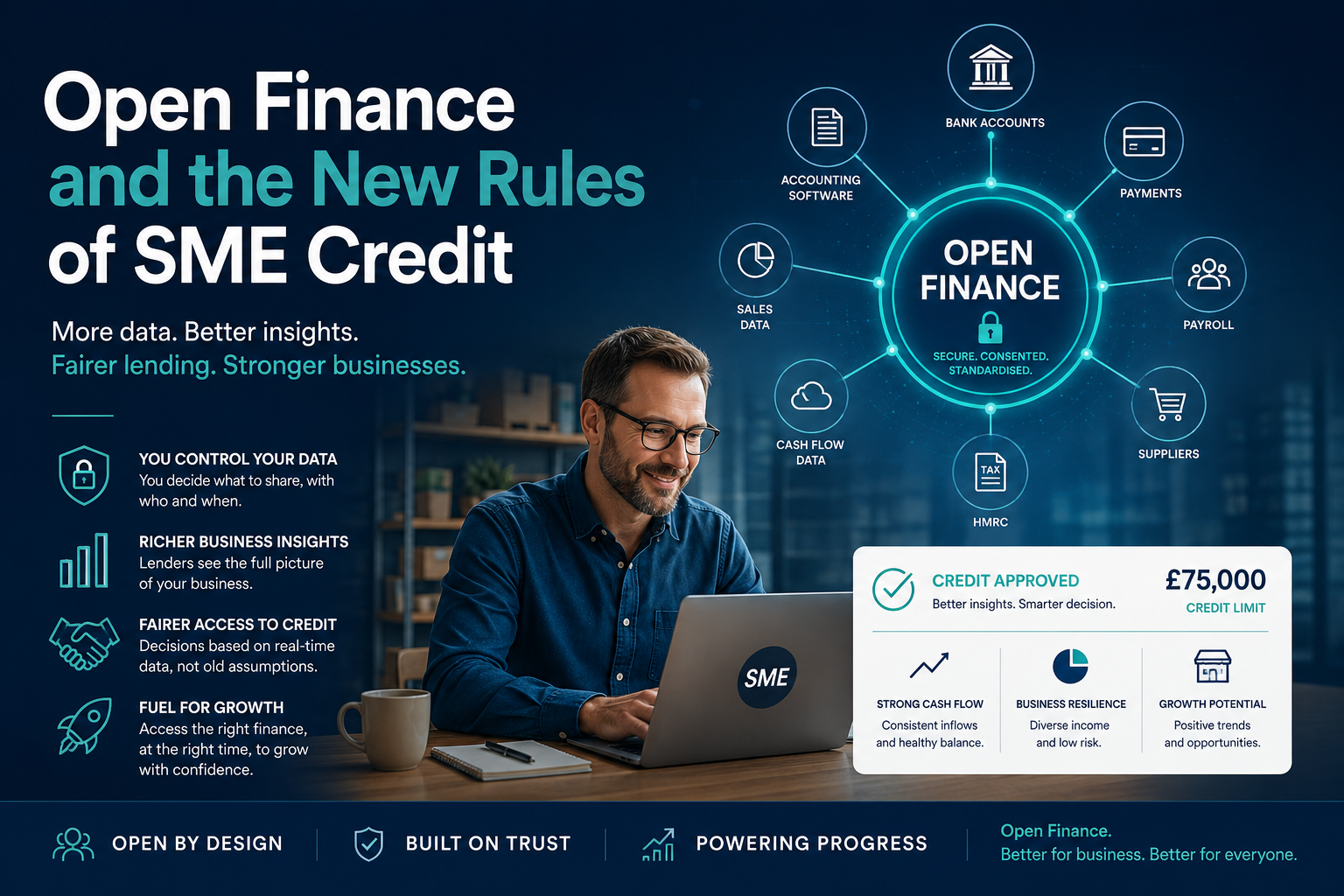
Open banking, and the broader open finance framework it sits inside, changes what a lender is actually looking at. Instead of a static picture, they get a live feed: real inflows, real outflows, the actual cash position of a business as it stands today, updated continuously with the applicant's consent.
That shift matters more than it sounds. A snapshot can only tell you what a business looked like once. A film shows you the pattern: how it handles a slow month, how quickly receivables convert to cash, whether a dip in April is a seasonal blip or the start of a problem. Lenders working from that richer picture are able to say yes to businesses that a credit-score-only model would have rejected on sight, and say no faster to the ones that genuinely aren't ready, which is better for everyone, including the borrower who wastes less time chasing a deal that was never going to close.
This is also why open finance is being treated as core infrastructure rather than an add-on feature. It doesn't replace underwriting judgment. It gives that judgment something real to work with.
A market is splitting into two tiers
The practical effect is a widening gap between the two types of lenders. On one side, lenders who are still working exclusively from static accounts and generic scoring will keep saying no to businesses they simply can't assess properly. On the other hand, lenders reading transaction-level data in real time, moving faster, taking on less blind risk, and reaching segments (sole traders, early-stage businesses, seasonal operators) that the first group can't serve profitably at all.
That split isn't a future scenario. It's already shaping which lenders win which deals, and it's exactly why open finance capability is becoming table stakes rather than a differentiator you can choose to skip.
Where FundingSearch fits
This is the part that matters most for brokers and lenders working with us. FundingSearch was built to connect SME borrowers with the right commercial finance brokers and lenders, and open finance is becoming part of how that matching happens, not just something we point applicants towards elsewhere.
When a business applies through FundingSearch, they can connect their real-time transaction data once, securely, with their consent. That verified financial picture (not a self-reported summary, not a stale set of accounts) becomes part of the profile we match against broker and lender criteria. Instead of an applicant scrambling to produce six months of bank statements for every lender in a shortlist, the data travels with them, verified once and usable across the matching process.
For a broker, that means less time spent chasing documentation and more time spent on the parts of the job that actually require judgment: structuring the deal, choosing the right lender relationship, and managing the client conversation. For a lender, it means the applications reaching them arrive with a clearer, more current financial picture attached, which shortens the distance between application and decision.
None of this changes who makes the lending decision. FundingSearch doesn't underwrite and doesn't lend. What it does is remove friction from the step before that decision gets made, so the businesses that deserve a fair look actually get one.
What this means for brokers
If you place deals through FundingSearch, the direction of travel is worth planning around now rather than reacting to later. Lenders are increasingly going to expect, and reward, applications that come with verified, real-time financial data attached. Clients who can be matched on the strength of an accurate, current picture rather than a stale one will close faster and get better terms. Brokers who build their client conversations around this shift, rather than treating it as a back-office detail, are the ones who'll keep winning the segments that used to be hardest to place: sole traders, newer businesses, anyone with a less conventional income pattern.
What this means for lenders
For lenders on the FundingSearch panel, the opportunity is straightforward: more of the applications you see will arrive already backed by verified, real-time data, which means less manual data-gathering on your end and a faster path to a confident decision. It also means access to a segment of creditworthy SME demand that's been effectively locked out of conventional scoring, not because the risk was too high, but because the visibility never existed to price it properly.
Where is this heading
Open finance in commercial lending is still early. The direction is clear, the economics make sense for lenders who move on it, and the businesses on the other side of the transaction (the ones who've spent years hearing "no" or "we can't tell you" from lenders that simply couldn't see them properly) stand to benefit the most.
FundingSearch's role is to make sure that shift happens inside the matching process itself, not as an afterthought bolted onto it. The businesses we work with shouldn't have to solve their own visibility problem. That's the part we're built to solve for them.
FAQs
What is open finance, in plain terms? It's the ability for a business to securely share its real financial data (bank transactions, and eventually a wider range of financial information) with lenders and platforms it chooses to work with, instead of relying only on filed accounts or a credit score.
Does FundingSearch lend money directly? No. FundingSearch connects SME borrowers with commercial finance brokers and lenders on our panel. Lending decisions are made by those brokers and lenders, not by FundingSearch.
Is my data shared without my consent? No. Open finance data sharing only happens with the applicant's explicit consent, and only with the brokers and lenders involved in matching their specific application.
Which businesses benefit most from this? Sole traders, early-stage businesses, and businesses with seasonal or variable income tend to benefit most, since these are the segments traditional credit scoring struggles to assess fairly.