

All Posts
10 min read
UK SME Lending Statistics Q2, 2026: Key Figures on Business Finance
Published on 25 September 2026

This guide is for business owners, brokers, lenders, and researchers seeking the latest UK SME lending statistics and trends. Understanding these figures is crucial for making informed business finance decisions and policy analysis. UK SME lending is at its highest level since the pandemic, but it is getting more expensive. Gross lending to SMEs by the main high street banks hit £5.35bn in Q2 2026, up 26% on a year earlier, while the average rate on new SME loans rose to 6.61% in July 2026, a shift that matters for the wider UK economy. This page gathers the latest official data from UK Finance, the Bank of England and the British Business Bank into one citable reference on UK SME lending statistics and the broader small business lending market, compiled by the team at FundingSearch, the SME lending marketplace connecting borrowers, brokers and lenders, and updated each quarter.
Key UK SME lending statistics 2026 at a glance
- £5.35bn — gross lending to SMEs by the main high street banks in Q2 2026, a new post-pandemic high (UK Finance).
- +26% — year-on-year growth in that gross lending, the tenth consecutive quarter of annual growth (UK Finance).
- One third below — gross lending in H1 2026 was still about a third below the 2019 average (UK Finance).
- £17.5bn — gross SME lending by the main high street banks in full-year 2025, up from £16.1bn in 2024 (UK Finance).
- £68bn — gross SME bank lending across all banks in 2025, up 9% and the second-highest level since 2012 (British Business Bank).
- £191bn — stock of bank lending to SMEs at December 2025, 12% higher than a year earlier (British Business Bank).
- 60% — share of gross SME bank lending provided by challenger and specialist banks in 2025, up from 39% in 2012 (British Business Bank).
- 4.1% — annual growth rate of bank borrowing by SMEs in July 2026, against 9.4% for large businesses (Bank of England).
- 6.61% — effective interest rate on new bank loans to SMEs in July 2026, up from 6.14% in January (Bank of England).
- 3.75% — Bank Rate, held on 17 September 2026 by a 6–3 vote, with three members voting for a rise to 4% (Bank of England).
- 51.4% — SME overdraft utilisation in June 2026, the highest since March 2020 (UK Finance).
- £25.6bn — record asset finance lending to SMEs in the 12 months to July 2026 (FLA via Finance Connect).
- £9.4bn — finance for smaller businesses supported by the British Business Bank in 2025–26 (Alternative Credit Investor).
- 48% — share of SMEs confident their bank would agree to a finance facility in Q3 2025 (British Business Bank).
Gross lending to SMEs in 2026
Gross lending to SMEs by the main high street banks reached £10.65bn in the first half of 2026. That is already 61% of the £17.5bn lent in the whole of 2025, and it covers only part of the wider SME market, which also includes challenger banks and non-bank lenders. Quarterly lending has now grown year on year for ten consecutive quarters, according to UK Finance's Business Finance Review 2026 Q2, published on 21 September 2026. Most of this is term lending: see our guide to bank business loans in the UK for how the high street banks price and assess applications.
| Period | Gross SME lending (main high street banks) | Change on a year earlier |
|---|---|---|
| Q2 2026 | £5.35bn | +26% |
| Q1 2026 | £5.3bn | +16% |
| Q4 2025 | £4.6bn | Eighth consecutive quarter of growth |
| Full year 2025 | £17.5bn | +8.7% (from £16.1bn in 2024) |
Sources: UK Finance Q2 2026 review, Q1 2026 review, 2025 annual release. UK Finance is the source for both the quarterly figures and annual gross bank lending by the main high street banks; growth for 2025 was calculated by FundingSearch.
Strong headline, softer finish to the quarter
The Q2 headline hides a turn in momentum. UK Finance says lending peaked around the turn of the quarter, with a clear inflection point as SME loan applications turned down at the end of March. Loan applications from medium-sized businesses fell 40% between March and April, and medium-firm lending weakened markedly through May and June.
Small firms saw the sharpest fall, reversing a spike in Q1, although their lending remained up on a year earlier. In Q1 2026, lending to the smallest businesses had jumped 51% year on year (UK Finance).
Still below pre-pandemic levels
Despite the post-pandemic high, UK Finance notes that gross lending in H1 2026 was still about a third below the 2019 average. The British Business Bank makes a similar point across the wider market: real-terms bank lending to SMEs has been below 2019 levels for three consecutive years (Small Business Finance Markets 2025/26).
Net lending and the stock of SME debt
Monthly Net Lending Trends
SMEs borrowed a net £0.8bn from banks in July 2026, and the annual growth rate of SME bank borrowing held at 4.1%, according to the Bank of England's Money and Credit July 2026 release. That growth rate has almost doubled from 2.4% in January 2026 (January release).
| Month (2026) | SME net bank lending | Effective rate on new SME loans | Annual growth, SME borrowing |
|---|---|---|---|
| January | £0.4bn | 6.14% | 2.4% |
| February | £0.5bn | 6.26% | 2.9% |
| March | £0.8bn | 6.11% | 3.7% |
| April | £1.0bn | 6.16% | 4.2% |
| May | −£0.1bn | 6.18% | 4.0% |
| June | £0.6bn | 6.36% | 4.1% |
| July | £0.8bn | 6.61% | 4.1% |
Source: Bank of England Money and Credit releases, January–July 2026. Figures as first published or first revised; subject to further revision.
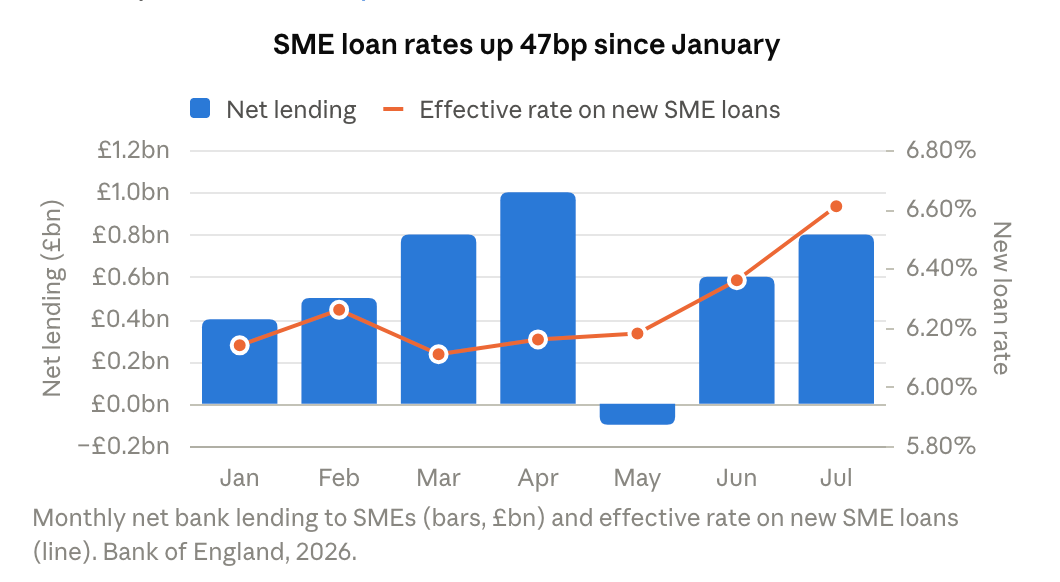
Net flows summed to roughly £4bn over January to July 2026, with March and April the strongest months and May a small net repayment (May release). SMEs are still borrowing far more slowly than large corporates, whose borrowing grew 9.4% in the year to July after peaking at 12.3% in April (April release).
| Measure | Latest figure | Source |
|---|---|---|
| Stock of bank lending to SMEs | £191bn (Dec 2025), +12% year on year | British Business Bank |
| SME net bank borrowing | £0.8bn (Jul 2026) | Bank of England |
| Annual growth, SME borrowing | 4.1% (Jul 2026) | Bank of England |
| Annual growth, large-business borrowing | 9.4% (Jul 2026) | Bank of England |
| Business deposit flows | £9.2bn net withdrawal (Jul 2026) | Bank of England |
Why the gap matters: UK Finance data measures gross new lending by the main high street banks. The Bank of England measures net flows across all UK banks for non-financial businesses, after repayments. Strong gross lending alongside modest net growth means firms are still servicing existing finance facilities and making repayments, including on pandemic-era debt.
SME finance demand, applications and approval rates
SME Confidence and Application Rates
Only about half of UK small businesses use external finance, and fewer than half are confident a bank would lend to them. The SME Finance Monitor found 50% of SMEs were using external finance in Q4 2025, and just 12% planned to apply for finance in the following three months (SME Finance Monitor, Q4 2025).
A significant number of SMEs operate without external finance, prioritising cash preservation. In fact, 86% of SMEs have no desire to borrow, and 35% of UK SMEs are permanent non-borrowers. This highlights a strong preference among many SMEs to avoid debt and maintain financial independence.
| Demand indicator | Figure | Period | Source |
|---|---|---|---|
| SMEs using external finance | 50% | Q4 2025 | SME Finance Monitor |
| Use by size: 0 / 1–9 / 10–49 / 50–249 employees | 38% / 58% / 70% / 73% | Q4 2025 | SME Finance Monitor |
| Permanent non-borrowers | 39% | Q4 2025 | SME Finance Monitor |
| SMEs planning to apply in next 3 months | 12% | Q4 2025 | SME Finance Monitor |
| Would-be applicants confident bank would agree | 39% | Q4 2025 | SME Finance Monitor |
| SMEs confident bank would agree (all) | 48% | Q3 2025 | British Business Bank |
| Finance sought for growth | 43% (34% in 2024) | 2025 | British Business Bank |
| Access to finance a major barrier | 8% (11% in 2012) | 2025 | British Business Bank |
| SMEs who know where to find finance information | 62% (+5 points) | 2025 | British Business Bank |
Approvals: 2026 opened strongly, then cooled
The value of new loan approvals rose 36% and the number rose 42% in Q1 2026 compared with Q1 2025 (UK Finance Q1 2026). In Q2, approvals were still higher than a year earlier across small and medium firms, but growth moderated. Overdraft approvals for small firms had a particularly strong end to the quarter, while medium-firm overdraft approvals weakened by value.
Approvals fell quarter on quarter in manufacturing, construction and accommodation and food. Those are the sectors most exposed to energy costs and weaker consumer spending. Firms in these sectors whose credit profile has weakened can review our guide to improving your credit for business loans before applying.
The confidence gap is the broker opportunity
Fewer than four in ten would-be applicants expect a bank to say yes. Yet 60% of gross SME bank lending now comes from challenger and specialist banks, and non-bank lenders supplied £18.3bn in 2025. Many SMEs that expect rejection from their main bank never reach the wider range of finance providers most likely to fund them. That is the gap commercial finance brokers, and marketplaces such as FundingSearch, exist to close. SMEs can start with a business loan comparison across bank and alternative funding options to compare finance options side by side.
Cost of borrowing: Bank Rate and SME interest rates in 2026
SME borrowing costs are rising even though Bank Rate has not moved: bank finance for smaller firms is getting more expensive. The effective rate on new bank loans to SMEs climbed from 6.14% in January to 6.61% in July 2026, while Bank Rate stayed at 3.75% (Bank of England). That leaves SMEs paying roughly 2.9 percentage points over Bank Rate on new loans, against about 1.9 points for all private non-financial companies (5.62%). Borrowers can model repayments at current rates with our business loan calculator.
| Rate | Latest | Source |
|---|---|---|
| Bank Rate | 3.75% (held 17 Sep 2026, 6–3 vote) | BoE Monetary Policy Summary |
| Effective rate, new SME loans | 6.61% (Jul 2026) | BoE Money and Credit |
| Effective rate, new loans to all PNFCs | 5.62% (Jul 2026) | BoE Money and Credit |
| CPI inflation | 3.1% (Aug 2026) | BoE Monetary Policy Summary |
| Average SME loan margin over Bank Rate | 2.27% (2025), down from 2.82% in 2016 | British Business Bank |
Rate rises back on the table
Three of nine Monetary Policy Committee members voted in September 2026 to raise Bank Rate to 4%. The Committee cited higher crude and refined energy prices linked to conflict in the Middle East. It projects CPI inflation of around 3.75% in Q4 2026 and slightly above 4% in Q1 2027.
For SMEs, the practical effect is that lenders are already pricing in risk. Borrowers on variable-rate facilities, and firms planning to borrow in late 2026, should review current facilities and stress-test cash flows rather than bank on cheaper money in the months ahead. Pricing gaps between secured business loans and unsecured business loans are likely to widen as lenders reprice risk.
SME lending by sector and firm size
Real estate and professional services drove SME lending growth in Q2 2026, while manufacturing and hospitality weakened. Sector lending trends also shape business investment, especially where firms are financing premises, equipment or expansion. UK Finance reports that gross lending in H1 2026 to manufacturing and hospitality was 6% and 1.5% lower respectively than a year earlier (UK Finance Q2 2026). Real estate demand is visible across commercial mortgages and bridging loans.
| Sector | Direction in 2026 | Detail |
|---|---|---|
| Real estate | Growing | Major contributor to Q2 growth; up over a third in Q1 |
| Professional services | Growing | Significant contributor to Q2 growth |
| Health | Growing | Contributed to Q2 growth |
| Agriculture | Growing | Up nearly a quarter in Q1; approvals kept rising in Q2 |
| Recreation and personal services | Growing | Up two thirds in Q1 |
| Transport and storage | Growing, slowing | Sharp fall in small-firm lending in Q2 |
| Wholesale and retail | Growing, slowing | Also the main driver of rising notice-account deposits |
| Construction | Under pressure | Q2 approvals down on Q1; above-average rise in overdraft use |
| Accommodation and food | Under pressure | Q2 approvals down on Q1; above-average rise in overdraft use |
| Manufacturing | Falling | H1 lending 6% lower year on year; Q2 approvals down |
Sources: UK Finance Q2 2026 and Q1 2026 releases.
Small versus medium firms
Smaller UK businesses led the recovery in 2025: small businesses (turnover up to £2m) saw gross lending rise by more than a quarter, against 4% for medium-sized firms (UK Finance). The pattern flipped in Q2 2026. Small-firm lending fell back from a Q1 spike, while medium-firm lending was more stable over the quarter as a whole, despite a 40% drop in medium-firm loan applications between March and April. Sole traders and firms with no employees remain the least likely to borrow: only 38% use external finance. We look at why mid-sized firms are underserved in the medium-sized business funding gap is real.
Beyond the big banks: asset finance, non-bank lenders and challengers
Most SME finance in the UK no longer comes from the traditional high street banks, and this diversification has widened the routes UK businesses have to access finance. Challenger and specialist banks provided 60% of gross SME bank lending in 2025, and 68% of all SME lending came from either challenger and specialist banks or non-bank lenders (British Business Bank).
| Market | Size | Period | Source |
|---|---|---|---|
| Asset finance to SMEs | £25.6bn, a record | 12 months to Jul 2026 | FLA via Finance Connect |
| Asset finance to smaller businesses | £24.4bn, highest on record | 2025 | British Business Bank |
| Total asset finance new business (all) | £41.7bn, +6% | 12 months to Jul 2026 | FLA |
| Non-bank lending to smaller businesses | £18.3bn | 2025 | British Business Bank |
| Challenger and specialist bank share of gross SME bank lending | 60% (39% in 2012) | 2025 | British Business Bank |
| New banking licences serving smaller businesses since 2013 | 28 of 69 | 2013–2025 | British Business Bank |
| Equity investment into smaller businesses | £7bn, −20% | Q1–Q3 2025 | British Business Bank |
| Equity deals | 1,238, −23% | Q1–Q3 2025 | British Business Bank |
Asset finance is outpacing bank loans
FLA members' SME asset finance lending grew 8% in July 2026, while lending to larger businesses fell 10%. Plant and machinery finance rose 9% and commercial vehicle finance 7%. "The asset finance market continued to grow in July, reflecting businesses' willingness to invest in the vehicles, machinery and equipment needed to drive productivity and growth," said Geraldine Kilkelly, FLA Director of Research. By spreading the cost of major purchases, asset finance also helps support cash flows.
Asset-backed products are also central to government-backed lending. Asset finance accounts for 5,815 of the 21,194 facilities written under the Growth Guarantee Scheme and Recovery Loan Scheme iteration 3, worth £840m (British Business Bank), funding business assets such as vehicles, machinery and equipment. For a side-by-side view, see asset finance vs business loans.
Overdraft use, cash buffers and repayments
Trends in Overdraft Utilisation
SMEs are leaning harder on overdrafts and running down cash reserves. Overdraft utilisation reached 51.4% in June 2026, the highest since March 2020, up from 49.3% at the end of Q1 (UK Finance Q2 2026; Q1 2026). The rise was seen across small and medium firms and in every sector, with larger increases in accommodation and food and in construction.
- Overdraft utilisation: 51.4% (Jun 2026), highest since Mar 2020 (UK Finance)
- Overdraft utilisation: 49.3% (Mar 2026), highest since Mar 2024 (UK Finance)
- SMEs using overdrafts: 16% (11% in 2024) (SME Finance Monitor Q4 2025)
- Total SME deposits: Just over 1% lower year on year (end Q1 2026) (UK Finance)
- Business deposit flows (all firms): £9.2bn net withdrawal (Jul 2026) (Bank of England)
- Bounce Back Loans fully repaid: 32% (Jun 2026) (UK Finance)
Deposits: drawing on reserves
Most sectors hold lower current account balances than a year ago, UK Finance says. Notice-account balances rose again in Q2, driven by wholesale and retail. Hospitality, transport and storage, and construction were drawing on reserves.
Repayments remain steady
UK Finance describes a broadly stable picture on SME repayments over the past two years. Most borrowers say they are moderately or very confident they can manage repayments. On pandemic-era debt, 32% of Bounce Back Loans had been fully repaid by June 2026, up from 19% in the previous quarter.
Government-backed finance and the regional picture
The British Business Bank supported £9.4bn of finance for smaller businesses across the UK in 2025–26, including £3.7bn of guaranteed lending (Alternative Credit Investor, reporting the Bank's Annual Report and Accounts 2026). It reached 30,000 businesses that had not previously received Bank-supported funding, 87% of them outside London.
| British Business Bank, 2025–26 | Figure |
|---|---|
| Total finance supported | £9.4bn |
| Guaranteed lending | £3.7bn |
| Private capital crowded in | £4.3bn |
| Public funding | £1.3bn |
| Newly supported businesses | 30,000 (87% outside London) |
| Businesses receiving follow-on funding | 8,000 |
| Expected additional jobs | 39,000 |
Growth Guarantee Scheme: what is being lent
By 31 March 2026, the Growth Guarantee Scheme and Recovery Loan Scheme iteration 3 had backed 21,194 facilities worth £3.64bn through more than 70 accredited lenders (British Business Bank). Accredited lenders include high street banks, specialist commercial lenders and online platforms. The most common facility size was £100,001–£250,000. Our guide to government-backed business loans explains eligibility and how the guarantee works.
| Product (GGS + RLS3, cumulative to 31 Mar 2026) | Facilities | Value |
|---|---|---|
| Business term loans | 14,907 | £2.69bn |
| Asset finance | 5,815 | £840m |
| Invoice finance | 453 | £98m |
| Revolving credit | 19 | £14.5m |
Regional spread
London accounts for 3,400 facilities worth £653m, about 16% of scheme facilities by number, followed by the South East (2,980; £480m) and the North West (2,367; £403m). UK Finance says high street bank lending in 2025 was evenly spread across UK regions. The British Business Bank still flags harder access for smaller businesses in deprived, rural and coastal areas.
UK Finance has called for the Growth Guarantee Scheme to be expanded. "There are steps we can take to help even more SMEs to thrive, such as expanding the government's Growth Guarantee Scheme," said David Raw, Managing Director for Commercial Finance (UK Finance).
Outlook for SME lending in H2 2026
Headwinds
- Energy costs and margins: Two-thirds of firms surveyed expect lower profit margins because of energy prices, and more than half plan to raise prices (UK Finance Q2 2026, citing business surveys). Oil passed $100 a barrel.
- Rates: The effective SME loan rate has risen 47 basis points since January, and a third of the MPC voted to hike in September, so the share of firms seeking finance may stay subdued.
- Slowing growth: UK GDP grew 0.4% in Q2 2026, down from 0.6% in Q1. The OBR forecasts 1.4% growth for 2026 (British Business Bank).
- Softer demand: Loan applications turned down from April, with only a small uptick in June.
Tailwinds
- Competition: More than 70 accredited GGS lenders and a 60% challenger and specialist share of bank lending give SMEs more finance options than ever.
- Asset finance: Record SME volumes show firms still investing in vehicles, plant and equipment.
- Deleveraging done: Steady repayments and falling pandemic debt leave many balance sheets with capacity to borrow.
Implications for Brokers, Lenders and Borrowers
Rising overdraft use and thinning cash buffers point to working capital demand in H2 from business customers: invoice finance, asset-based lending and trade finance can all help support cash flows. Firms that expect a "no" from their main bank should compare the wider market, including specialist small business loans, before they apply. For brokers, the widening gap between main-bank confidence (39–48%) and actual market capacity is the core opportunity. Lenders seeking pre-qualified SME deal flow, borrowers and brokers can search across nine asset classes on FundingSearch. For the data-sharing trends reshaping credit decisions, see our companion report on open finance and open banking SME lending statistics 2026.
Frequently asked questions
How much do banks lend to UK SMEs each year?
Annual gross bank lending to SMEs across all UK banks reached £68bn in 2025, excluding overdrafts, according to the British Business Bank. On UK Finance's narrower measure of the main high street banks, gross SME lending was £17.5bn in 2025 and £10.65bn in the first half of 2026. The gap shows how far smaller business finance markets extend beyond the main high street banks.
Is SME lending rising or falling in 2026?
Rising. Gross lending hit £5.35bn in Q2 2026, up 26% year on year and a post-pandemic high. Net bank lending to SMEs grew 4.1% in the year to July 2026. Momentum slowed from April, however, and lending is still about a third below 2019 levels.
What interest rate do SMEs pay on business loans in 2026?
The average effective rate on new bank loans to SMEs was 6.61% in July 2026, according to the Bank of England. That compares with Bank Rate of 3.75% and 5.62% for all non-financial companies. Rates on specific products vary; see business loans in the UK.
What share of SME lending comes from challenger banks?
Challenger and specialist banks provided 60% of gross SME bank lending in 2025, up from 39% in 2012. Including non-bank lenders, 68% of SME lending came from outside the traditional big banks.
How many SMEs use external finance?
About half. The SME Finance Monitor found 50% of SMEs used external finance in Q4 2025, rising to 73% of firms with 50–249 employees but only 38% of sole traders and other firms with no employees. 39% are permanent non-borrowers.
How big is the UK asset finance market for SMEs?
Asset finance lending to SMEs reached a record £25.6bn in the 12 months to July 2026, according to the Finance & Leasing Association. Unlike venture capital, which funds high-growth equity stakes, asset finance is typically used to fund equipment and vehicles. See asset finance for small businesses for how it works.
Methodology, sources and how to cite
This page combines three official sources that track SME lending from different angles, reflecting how the UK built a more diversified SME finance ecosystem after the global financial crisis, so figures are not directly additive.
- Gross lending: The total amount of new loans and credit facilities provided to SMEs over a given period, before repayments are deducted. It reflects the flow of new finance entering the market.
- Net lending: The difference between new lending and repayments over a period. Positive net lending means more is being lent than repaid; negative net lending means repayments exceed new lending.
- Stock of bank lending: The total outstanding balance of loans to SMEs at a specific point in time. This represents the cumulative amount of SME debt still owed to banks.
- UK Finance — gross new lending, approvals, applications and overdraft utilisation from the main high street banks. Quarterly, via the Business Finance Review.
- Bank of England — net lending flows, growth rates and effective interest rates across all UK banks. Monthly, via Money and Credit. Figures are shown as first published or first revised and may be revised again.
- British Business Bank — whole-market view including all banks, non-bank lenders, asset finance and equity. Annual, via Small Business Finance Markets, plus scheme performance data. The Bank was established in November 2014 following post-crisis efforts to broaden SME finance markets.
Supporting data comes from the Finance & Leasing Association and the SME Finance Monitor, which show how the business population uses different finance products. Percentages marked as calculated by FundingSearch are derived from the published figures.
How to cite this page: "UK SME Lending Statistics 2026, FundingSearch, September 2026, fundingsearch.com." Journalists and researchers are welcome to use any statistic here with a link to this page.
Sources
- UK Finance, Business Finance Review 2026 Q2, September 2026
- UK Finance, Business Finance Review 2026 Q1, June 2026
- UK Finance, SME lending hits post-pandemic high, 11 June 2026
- UK Finance, SME lending increases for second consecutive year, 12 March 2026
- The Intermediary, SME lending hits post-pandemic high in Q2, 21 September 2026
- Bank of England, Money and Credit: January, February, March, April, May, June, July 2026
- Bank of England, Monetary Policy Summary, September 2026
- British Business Bank, Small Business Finance Markets 2025/26, March 2026
- British Business Bank, press release, 17 March 2026
- British Business Bank, GGS (including RLS iteration 3) performance data, 31 March 2026
- Alternative Credit Investor, British Business Bank supports £9.4bn of finance for SMEs in 2025-26, 21 July 2026
- Finance Connect (FLA data), Asset finance new business grows 2% in July, 23 September 2026
- BVA BDRC / Ipsos, SME Finance Monitor, 3 months to December 2025Regional spread
London accounts for 3,400 facilities worth £653m, about 16% of scheme facilities by number, followed by the South East (2,980; £480m) and the North West (2,367; £403m). UK Finance says high street bank lending in 2025 was evenly spread across UK regions. The British Business Bank still flags harder access for smaller businesses in deprived, rural and coastal areas.
UK Finance has called for the Growth Guarantee Scheme to be expanded. "There are steps we can take to help even more SMEs to thrive, such as expanding the government's Growth Guarantee Scheme," said David Raw, Managing Director for Commercial Finance (UK Finance).
Outlook for SME lending in H2 2026
Headwinds
- Energy costs and margins: Two-thirds of firms surveyed expect lower profit margins because of energy prices, and more than half plan to raise prices (UK Finance Q2 2026, citing business surveys). Oil passed $100 a barrel.
- Rates: The effective SME loan rate has risen 47 basis points since January, and a third of the MPC voted to hike in September, so the share of firms seeking finance may stay subdued.
- Slowing growth: UK GDP grew 0.4% in Q2 2026, down from 0.6% in Q1. The OBR forecasts 1.4% growth for 2026 (British Business Bank).
- Softer demand: Loan applications turned down from April, with only a small uptick in June.
Tailwinds
- Competition: More than 70 accredited GGS lenders and a 60% challenger and specialist share of bank lending give SMEs more finance options than ever.
- Asset finance: Record SME volumes show firms still investing in vehicles, plant and equipment.
- Deleveraging done: Steady repayments and falling pandemic debt leave many balance sheets with capacity to borrow.
Implications for Brokers, Lenders and Borrowers
Rising overdraft use and thinning cash buffers point to working capital demand in H2 from business customers: invoice finance, asset-based lending and trade finance can all help support cash flows. Firms that expect a "no" from their main bank should compare the wider market, including specialist small business loans, before they apply. For brokers, the widening gap between main-bank confidence (39–48%) and actual market capacity is the core opportunity. Lenders seeking pre-qualified SME deal flow, borrowers and brokers can search across nine asset classes on FundingSearch. For the data-sharing trends reshaping credit decisions, see our companion report on open finance and open banking SME lending statistics 2026.
Frequently asked questions
How much do banks lend to UK SMEs each year?
Annual gross bank lending to SMEs across all UK banks reached £68bn in 2025, excluding overdrafts, according to the British Business Bank. On UK Finance's narrower measure of the main high street banks, gross SME lending was £17.5bn in 2025 and £10.65bn in the first half of 2026. The gap shows how far smaller business finance markets extend beyond the main high street banks.
Is SME lending rising or falling in 2026?
Rising. Gross lending hit £5.35bn in Q2 2026, up 26% year on year and a post-pandemic high. Net bank lending to SMEs grew 4.1% in the year to July 2026. Momentum slowed from April, however, and lending is still about a third below 2019 levels.
What interest rate do SMEs pay on business loans in 2026?
The average effective rate on new bank loans to SMEs was 6.61% in July 2026, according to the Bank of England. That compares with Bank Rate of 3.75% and 5.62% for all non-financial companies. Rates on specific products vary; see business loans in the UK.
What share of SME lending comes from challenger banks?
Challenger and specialist banks provided 60% of gross SME bank lending in 2025, up from 39% in 2012. Including non-bank lenders, 68% of SME lending came from outside the traditional big banks.
How many SMEs use external finance?
About half. The SME Finance Monitor found 50% of SMEs used external finance in Q4 2025, rising to 73% of firms with 50–249 employees but only 38% of sole traders and other firms with no employees. 39% are permanent non-borrowers.
How big is the UK asset finance market for SMEs?
Asset finance lending to SMEs reached a record £25.6bn in the 12 months to July 2026, according to the Finance & Leasing Association. Unlike venture capital, which funds high-growth equity stakes, asset finance is typically used to fund equipment and vehicles. See asset finance for small businesses for how it works.
Methodology, sources and how to cite
This page combines three official sources that track SME lending from different angles, reflecting how the UK built a more diversified SME finance ecosystem after the global financial crisis, so figures are not directly additive.
- Gross lending: The total amount of new loans and credit facilities provided to SMEs over a given period, before repayments are deducted. It reflects the flow of new finance entering the market.
- Net lending: The difference between new lending and repayments over a period. Positive net lending means more is being lent than repaid; negative net lending means repayments exceed new lending.
- Stock of bank lending: The total outstanding balance of loans to SMEs at a specific point in time. This represents the cumulative amount of SME debt still owed to banks.
- UK Finance — gross new lending, approvals, applications and overdraft utilisation from the main high street banks. Quarterly, via the Business Finance Review.
- Bank of England — net lending flows, growth rates and effective interest rates across all UK banks. Monthly, via Money and Credit. Figures are shown as first published or first revised and may be revised again.
- British Business Bank — whole-market view including all banks, non-bank lenders, asset finance and equity. Annual, via Small Business Finance Markets, plus scheme performance data. The Bank was established in November 2014 following post-crisis efforts to broaden SME finance markets.
Supporting data comes from the Finance & Leasing Association and the SME Finance Monitor, which show how the business population uses different finance products. Percentages marked as calculated by FundingSearch are derived from the published figures.
How to cite this page: "UK SME Lending Statistics 2026, FundingSearch, September 2026, fundingsearch.com." Journalists and researchers are welcome to use any statistic here with a link to this page.
Sources
- UK Finance, Business Finance Review 2026 Q2, September 2026
- UK Finance, Business Finance Review 2026 Q1, June 2026
- UK Finance, SME lending hits post-pandemic high, 11 June 2026
- UK Finance, SME lending increases for second consecutive year, 12 March 2026
- The Intermediary, SME lending hits post-pandemic high in Q2, 21 September 2026
- Bank of England, Money and Credit: January, February, March, April, May, June, July 2026
- Bank of England, Monetary Policy Summary, September 2026
- British Business Bank, Small Business Finance Markets 2025/26, March 2026
- British Business Bank, press release, 17 March 2026
- British Business Bank, GGS (including RLS iteration 3) performance data, 31 March 2026
- Alternative Credit Investor, British Business Bank supports £9.4bn of finance for SMEs in 2025-26, 21 July 2026
- Finance Connect (FLA data), Asset finance new business grows 2% in July, 23 September 2026
- BVA BDRC / Ipsos, SME Finance Monitor, 3 months to December 2025