

All Posts
4 min read
Loan Calculator for Business: How to Accurately Cost Your Funding
Published on 10 July 2026
Introduction: Why a Business Loan Calculator Matters in 2026
If you are a business owner weighing up a new equipment purchase, bridging a revenue gap, or refinancing expensive debt, the single most useful thing you can do before signing anything is run the numbers. A business loan calculator helps estimate the cost of borrowing money before you commit, and using a loan calculator helps improve financial decision-making at a stage when mistakes are still free.
Here is why this matters right now for UK businesses:
- A business loan calculator lets you estimate monthly repayments, total interest, and the true annual percentage rate (including fees) before you submit a single application. No guesswork, no surprises.
- Concrete use cases are everywhere: funding a £50,000 equipment purchase, smoothing cash flow gaps of £25,000 to £100,000, or refinancing existing debt that carries punishing rates or hidden commissions.
- Online business loans now commonly run from £10,000 to £2 million, with loan terms from 6 months to 10 years depending on product type. That range is wide enough to make a calculator essential for testing scenarios quickly.
- FundingSearch is a UK commercial finance platform that uses verified financial data from sources like Companies House, Xero, and Sage, combined with AI matching, to connect borrowers with lenders. Its calculators and tools sit at the "shopping around" stage, helping SMEs, brokers, and lenders model realistic funding options before full applications begin
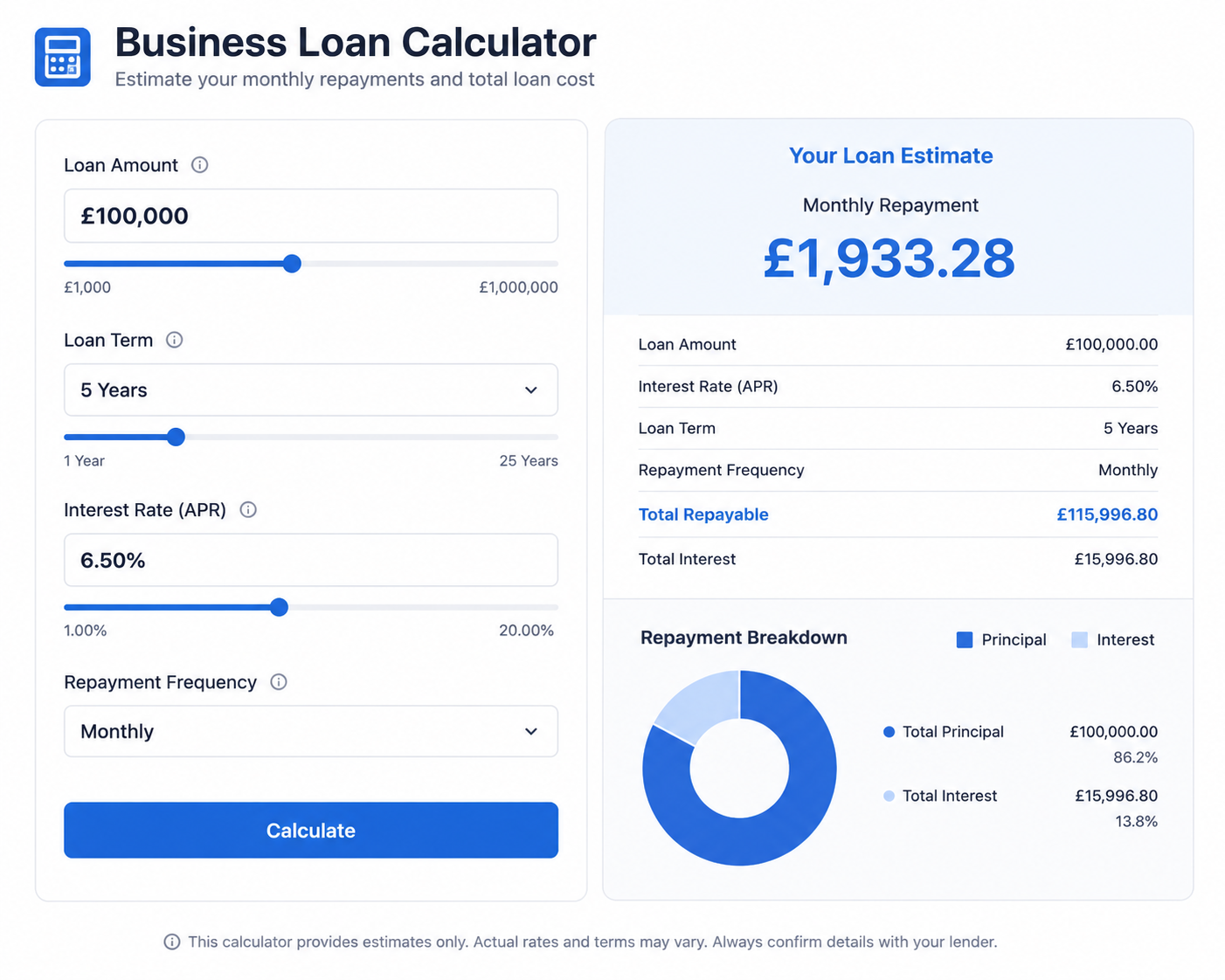
Business loan calculator
Business Loan Calculator
Estimate monthly repayments and the total cost of a business loan, with interest calculated on the reducing balance rather than a flat rate.
Loan Inputs
Loan amount£50,000
£
Interest rate (reducing balance)6.9% p.a.
A nominal annual rate, charged monthly on the outstanding balance only, so it falls as the loan is repaid.
Arrangement fee1.5%
Charged on the loan amount and added to the balance you repay.
Loan term60 months (5 years)
Results
Amount received£50,000.00
Arrangement fee£750.00
Total amount financed£50,750.00
Total interest£9,401.09
Total repayable£60,151.09
Estimated monthly repayment£1,002.52
Equivalent annualised APR7.8%
Figures are illustrative only. The quoted rate is a nominal annual rate divided by 12 to give a monthly rate, charged on a reducing-balance (amortising) basis: each monthly repayment is fixed, but the split between interest and capital shifts over the term as the outstanding balance falls, so total interest is lower than an equivalent flat rate. The arrangement fee is added to the loan and repaid over the term. The equivalent APR is the actuarial (compound) annual rate implied by the amount received today against the equal monthly repayments — the same method used for a regulated APR — and will exceed the quoted nominal rate because of the arrangement fee and monthly compounding. Actual rates, fees and terms are subject to lender underwriting and status. This is not a credit offer or financial advice.

What Is a Business Loan Calculator?
A business loan calculator is an online tool that estimates repayments and total cost for business finance based on a few core inputs. You input loan amount, interest rate, and term to estimate monthly repayments, giving you a clear view of what a facility will actually cost before you approach a lender.
Business loan calculators estimate monthly repayments and total costs across different commercial finance products, including term loans, asset finance, commercial mortgages, and working capital loans. Calculators provide estimates without impacting credit scores, so there is zero risk in running as many scenarios as you like.
Typical Inputs
- Loan amount, commonly from £10,000 to £1,000,000 or more for UK SMEs
- Loan term, ranging from 6 months up to 120 months (10 years) for most products
- Annual interest rate, either fixed or variable
- Business loan fees such as a 2% arrangement fee or flat documentation charge
Typical Outputs
- Monthly repayment amount
- Total interest paid over the life of the loan
- Total fees payable
- Total amount repayable (principal plus interest plus fees)
Business loan calculators can also generate an amortisation schedule detailing payments month by month, showing how much goes toward principal versus interest at each stage. A business loan calculator provides an amortisation schedule that helps with budgeting and cash flow forecasting. Effective calculators should include features like fee inclusion and flexible terms so you can model realistic scenarios rather than best-case fantasies.
FundingSearch's platform goes further by embedding lender-specific rules and risk pricing bands, so the rates and fees you test are closer to what real financial institutions will actually offer.
How to Use a Business Loan Calculator Step by Step
This section walks you through a practical process for modelling business finance costs. Follow these steps each time you evaluate a funding option.
- Step 1: Decide the Purpose
Decide the purpose of the finance. An £80,000 loan for new machinery via asset finance requires different inputs than a £40,000 working capital loan for stock. The purpose shapes the product type, term, and security expectations. - Step 2: Enter Loan Amounts
Enter different loan amounts to test sensitivity. Calculators allow testing of various loan amounts, terms, and interest rates, so try £25,000, £150,000, and £500,000. Smaller unsecured loans tend to carry higher rates; larger amounts may require security. - Step 3: Select the Loan Term
Select the loan term. Try 12, 36, and 60 months. Longer terms lower monthly payments but increase total interest. A five-year term on a £50,000 small business loan might halve the monthly payment compared to two years but cost thousands more overall. - Step 4: Input the Annual Interest Rate
Input the annual interest rate. Test realistic scenarios such as 8.9% versus 13.5%. Even a few percentage points dramatically change repayment amounts. Knowing estimated repayments assists in determining loan affordability before you go any further. - Step 5: Add Estimated Fees
Add estimated fees. Include a 2% arrangement fee plus a £250 documentation flat fee so the calculator can approximate the loan's actual cost and indicative APR. - Step 6: Review Outputs
Review outputs. Business loan calculators enable comparison of different financing scenarios side by side. For example, a £50,000 loan over three years at 8.9% might cost roughly £1,590 per month with around £7,200 in total interest. Stretch that to five years and your monthly payment drops to about £1,035, but total interest climbs above £12,000. Comparing repayments against business cash flow helps assess whether a loan fits your operating budget.
FundingSearch can then match these preferences with real-time offers from multiple lenders to validate whether your calculator assumptions hold up against live market pricing.

Understanding Key Calculator Inputs: Amount, Term, and Annual Interest Rate
Three variables drive every calculator result: how much you borrow, how long you take to repay, and what rate you pay. Getting these right determines whether your estimate is useful or misleading.
Loan Amount
UK SME borrowing bands in 2025–2026 typically fall into £10,000–£100,000 for working capital and unsecured loans, and £100,000–£1 million or more for property-backed and asset finance deals. Microloans typically range from £1,000 to £25,000 for small businesses needing modest sums. Users can input loan amount and term for calculations to see how size affects repayments.
Loan Term
Typical repayment terms for business loans range from months to decades. Working capital facilities often run 6–36 months. Unsecured term loans stretch up to 5–7 years. Commercial mortgages can extend to 25 years. The repayment period you choose has a direct trade-off: shorter means higher monthly outlay but lower annual cost overall.
Annual Interest Rate
Interest rates for business loans vary based on creditworthiness. In the UK market, strong applications on secured deals might see 4–10% APR, while unsecured business loans for moderate-risk borrowers commonly land between 6% and 15% APR. Higher-risk profiles can face 20–30% or more. Always distinguish between the nominal rate (interest only) and the annual percentage rate, which folds in mandatory fees for a fairer comparison.
Fees as an Input
Origination fees range from 1% to 6% of the loan amount. Arrangement fees, documentation charges, and broker fees should all be entered so the calculator approximates the true borrowing costs rather than just the headline rate. FundingSearch collects lender-specific pricing bands, so brokers and SMEs can compare realistic rate ranges instead of relying on generic market averages.
What Does a Business Loan Calculator Show You?
The outputs from a calculator go well beyond a single monthly repayment figure. Here is what to look for and why each number matters.
Monthly or Quarterly Repayments
Most business loans require monthly repayments, and a calculator shows this as its headline output. Some asset finance or invoice financing products structure payments differently, but the monthly payment remains the standard for term loans and commercial mortgages. Understanding monthly obligations helps prevent cash flow bottlenecks before they happen.
Total Interest Paid
Business loans require repayment of both the principal and interest, and the total interest figure reveals the real cost of time. A £50,000 loan over three years at 6% might cost around £4,800 in total interest. Extend that to six years and total interest could exceed £9,500, even though the monthly repayment drops. A business loan calculator aids in cash flow management and budgeting by making this trade-off visible.
Total Cost of Credit
This combines interest plus all business loan fees into a single total repayable figure. On that same £50,000 loan with a 2% arrangement fee (£1,000) and £250 in documentation costs, total repayable might reach approximately £56,050 over three years. That number is what actually leaves your business bank account.
Indicative APR
Calculators can include fees to determine the true APR, which is the single best number for comparing offers from different financial institutions. Short-term loans amplify fee impact, so APR is especially revealing on 12-month facilities.
Amortisation Schedule
Some calculators generate a month-by-month breakdown showing how much of each payment goes toward principal versus how much you pay interest. This is useful for tax planning, early repayment modelling, and cash flow forecasting. Loan calculators can also highlight the impact of extra repayments on interest, helping you see whether paying a loan early saves meaningful money.
How Calculated Costs Differ Across Common Business Finance Types
Calculators behave differently depending on whether you are modelling a term loan, asset finance, invoice finance, or revolving credit. Each product has its own cost structure, and a one-size-fits-all approach will mislead you.
Term Business Loan
Term loans are repaid over a set period with fixed payments, making them the simplest to model. A £75,000 traditional business loan over five years at 8% fixed interest rate gives roughly £1,520 per month, with total interest around £16,200. Traditional loans like these are the bread and butter of most business loan calculators.
Asset Finance
Hire purchase and finance lease structures typically run 2–7 years, with the asset itself as security. Balloon payments sometimes feature at the end, meaning lower monthly payments but a lump sum due at maturity. A calculator must account for this or the monthly repayment amount will look misleadingly low.
Commercial Mortgage
Longer terms of 10–25 years mean much larger total interest. A £400,000 commercial mortgage over 15 years at 7% could see total repayable exceed £645,000 once you add arrangement fees and valuation costs, and some borrowers may also consider interest-only commercial mortgage structures to manage cash flow. The monthly interest portion is high in early years and gradually reduces.
Invoice Finance
Invoice financing provides cash advances of 80% to 95% of invoice value, with cost typically expressed as a percentage per 30 days rather than a traditional amortisation. A calculator for invoice financing usually models cost against invoice value and debtor payment speed.
Revolving Credit and Business Credit Cards
These products charge interest on a rolling balance. A calculator models scenarios based on utilisation - for instance, drawing 40% of a £50,000 line at 15% APR versus full utilisation. Business overdrafts work similarly and need usage-based modelling.
Merchant Cash Advance
Merchant cash advances use future sales as leverage for quick funding, with repayments taken as a percentage of daily card receipts. Such loans are harder to model in standard calculators because the repayment schedule fluctuates with revenue.
For comparison purposes, in the US market SBA loans can be as large as $5 million for up to 10 years and SBA loans can reach up to $5 million for various purposes, though UK SMEs more commonly use government backed loans like the Growth Guarantee Scheme for similar support.
FundingSearch's matching engine considers these different cost structures when presenting comparable funding options to borrowers and brokers.

Secured vs Unsecured Business Loans: What the Calculator Can Reveal
Calculators help visualise the trade-off between lower rates with security and the flexibility of unsecured borrowing.
Secured business loans require collateral - commercial property, vehicles, machinery, or other business assets - and typically carry business loan interest rates 2–5 percentage points lower than unsecured equivalents. For strong applications, secured rates in the UK often sit around 3–8% APR.
Unsecured loans rely on business credit score, credit history, and trading history. They are usually available for £10,000–£350,000 with shorter terms and higher rates, commonly 6–15% APR for creditworthy borrowers. Many traditional lenders and alternative funding options require a personal guarantee even on unsecured facilities, blurring the line between the two.
Consider this scenario: a £150,000 secured loan at 7% over six years costs roughly £2,553 per month, with total interest around £33,800. The same amount unsecured at 12% over the same repayment terms costs approximately £2,936 per month, with total interest exceeding £61,400. That is nearly £28,000 in extra interest charges - the actual cost of avoiding security.
FundingSearch lets users filter lenders by whether they require security or personal guarantees, so you can compare these scenarios with actual loan options rather than hypothetical rates.
Business Loan Fees and Their Impact on Total Cost
Many business owners underestimate fees, and calculators are essential for seeing their real impact on total cost and APR.
Arrangement or Origination Fees
Typically 1–3% of the loan amount for standard products, though specialist facilities can charge up to 5–6%. A 2% fee on a £100,000 actual loan is £2,000 deducted upfront or added to the balance. On a short 12-month facility, arrangement fees alone can push the effective APR several points above the headline rate.
Documentation Fees
Documentation fees cover the cost of processing paperwork and commonly range from £250 to £995 as a flat fee.
Valuation and Legal Fees
Common in commercial property and asset finance, these can run from £1,000 for simple assets to £8,000 for complex commercial properties. Application fees may be charged upfront to review loan applications before approval.
Broker Fees
Where intermediaries charge the borrower directly - typically 1–2% - this should be factored into total borrowing costs. Transparency varies, so always ask and include it in your calculator inputs.
Early Repayment and Exit Fees
Prepayment penalties may be charged for paying off loans early, often equivalent to 1–3 months' interest. If you plan to pay a loan early or take a repayment holiday, model this scenario in the calculator to understand the exact payment terms. Late payment fees apply if payments are not made on time, adding further to costs if cash flow tightens.
FundingSearch's data-driven profiles incorporate typical fee structures from different lenders, helping brokers and SMEs build more accurate calculator inputs from the start.
How Your Business Credit Score Affects Calculator Results
Calculators require you to assume an interest rate, but in reality that rate depends heavily on your business credit score and financial health.
In the UK, lenders use ratings from Experian, Equifax, and Creditsafe to price risk. Key factors affecting your credit score include payment history, CCJs, timely filing of financial statements at Companies House, leverage levels, and sector risk. A good credit score opens access to lower rates and larger loan amounts.
The impact is substantial. Model a £100,000 loan over five years: at 8% APR (strong credit, possibly secured) the monthly payment is roughly £2,028 with total interest around £21,700. At 18% APR (weaker credit, unsecured) the monthly payment jumps to approximately £2,540 with total interest exceeding £52,400, illustrating the kind of pricing faced by businesses seeking bad credit business loans in the UK. That is more than double the interest - a difference that could fund an entirely separate project.
FundingSearch uses verified data feeds from Xero, Sage, and Companies House so that lenders can price more accurately. This means borrowers with solid personal finances and clean trading records may access funds at rates better than generic calculator assumptions suggest, as explored in Open Finance, Open Banking & SME Lending Statistics (2026) and broader guides on fintech innovation in UK commercial finance.
Using Business Loan Calculators to Compare Funding Options
Calculators are most powerful when you compare multiple funding options side by side rather than running a single quote.
Imagine an SME needing £60,000. Here are three scenarios worth modelling:
- An unsecured term loan at 12% over five years gives a monthly payment of about £1,335 with total repayable around £80,100. Stable, predictable, but higher cost for those looking to compare standard UK business loans.
- An asset finance agreement at 9% over four years (with equipment as security) gives roughly £1,493 per month but total repayable closer to £71,700. Lower total cost, but you need an eligible asset.
- A revolving credit line of £60,000 at 15% APR used at 40% average utilisation costs roughly £300 per month in monthly interest alone, with flexibility to draw and repay, which can be particularly relevant when exploring emergency business loan options. More agile for working capital, but potentially expensive if utilisation stays high.
Comparing actual repayments and total costs across these structures reveals which product suits your business structure and cash flow pattern. FundingSearch's marketplace sends a single application to multiple lenders and lets business finance experts, brokers, and borrowers compare actual offers against initial calculator estimates - without affecting your credit score through multiple scattered applications.
Worked Example: Modelling a £100,000 Business Loan in 2025–2026
Let us walk through a single detailed example using realistic 2025–2026 UK rates and terms.
Scenario: A limited company in Sheffield wants to borrow £100,000 over five years to invest in equipment and marketing. Two lenders provide indicative terms.
Offer A: 9.5% annual interest rate with a 2% arrangement fee (£2,000) plus £500 in documentation and legal fees. Over 60 months, this gives a monthly repayment of approximately £2,100. Total interest comes to roughly £26,000, and total fees add £2,500. The total repayable sits around £128,500.
Offer B: 12.9% annual interest rate with no arrangement fees - only a £250 documentation fee. Monthly repayment rises to around £2,270. Total interest over five years reaches approximately £36,200, with fees of just £250. Total repayable: roughly £136,450.
Even though Offer B has no origination fees, its higher rate means it costs nearly £8,000 more over the full term. The loan agreement details matter: if Offer A penalises early repayment heavily and you plan to settle in year three, the calculus might shift. Always model the exact payment terms and early settlement cost.
For weaker credit, the same £100,000 over five years at 18% with a 3% arrangement fee would push the monthly payment above £2,540 and total repayable well past £155,000 - a stark reminder of how credit score shapes actual loan costs.
FundingSearch helps SMEs and brokers source these competing offers in one place, then refine the choice using commercial lending software and its commercial finance lending platform powered by verified financial data.

How FundingSearch Helps You Go Beyond Simple Calculators
FundingSearch is a B2B SaaS marketplace founded in 2025 in Sheffield, focused on UK commercial finance deal origination. Unlike a standalone business loan calculator, it connects SMEs, brokers, and lenders through an AI-driven matching engine that turns calculator estimates into actionable, real-world offers.
Key features relevant to loan costing include integrations with Companies House, Xero, and Sage to pull verified financial data and improve accuracy of affordability assessments. This means the gap between what a calculator estimates and what a lender actually offers narrows significantly.
The platform covers seven asset classes: business loans, asset finance, commercial mortgages, bridging, invoice finance, asset-based lending, and trade finance. This breadth lets business customers compare cost and structure across product types rather than evaluating traditional lending in isolation.
For brokers and lenders, FundingSearch subscriptions deliver pre-qualified deals where initial numbers from calculators align with live lender appetite and pricing. SMEs can explore realistic loan options at low or no cost without harming their credit score through multiple applications. Whether you are looking at traditional business loans, alternative funding options, or specialist products, the platform streamlines the journey from estimate to offer.
FundingSearch's launch and approach to verified SME lending data have been covered by City AM, Yahoo Finance, and other UK fintech and finance titles.
Practical Tips for Using Loan Calculators Without Harming Your Credit Score
Using online banking tools and calculators is completely risk-free for your credit file. No hard credit search occurs until you submit a formal application. But moving from calculator to application needs care.
- Treat calculator results as estimates, not guarantees. Adjust rate, term, and fee assumptions slightly upward to stress-test whether your cash flow can absorb a worse-than-expected scenario.
- Avoid applying separately to many traditional lenders or credit unions based on rough figures. Every full application typically triggers a hard search that can affect your score.
- Consolidate applications via a platform like FundingSearch to reduce duplicate credit checks and unnecessary searches.
- Save or export calculator results. Share them with your accountant or business finance experts to validate assumptions before committing to a loan agreement.
- Model what happens if you need a repayment holiday or want to settle early. Understanding these scenarios upfront prevents costly surprises from personal guarantee triggers or exit fees.
FAQs About Business Loan Calculators and Commercial Finance
Does using a business loan calculator affect my credit score?
No. Running scenarios in a calculator does not trigger any credit search. You can model as many combinations of loan amount, term, and rate as you need without affecting your credit score. Only formal applications to lenders or brokers involve credit checks.
How accurate are repayment figures compared to real lender offers?
Accuracy depends entirely on how realistic your inputs are. If you assume a 6% rate but your credit history only qualifies you for 14%, the calculator output will be optimistic. Platforms that pull verified data - like FundingSearch - narrow this gap by using lender-specific pricing bands rather than market averages.
Can I use one calculator for both business loans and asset finance?
Sometimes. A standard calculator handles term loans well, but asset finance involves balloon payments, residual values, and lease-versus-purchase distinctions. For precision, use a product-specific calculator when modelling hire purchase or finance lease structures. A personal loan calculator will not work for commercial products at all.
What is the difference between interest rate and APR in the calculator?
The nominal interest rate is the annual cost of borrowing the principal only. The annual percentage rate includes mandatory fees like arrangement fees, origination fees, and sometimes valuation costs. APR gives you a better basis for comparing offers because it reflects the loan's actual cost, not just the headline rate.
How do I choose between fixed and variable rate business loans?
A fixed interest rate gives certainty: your repayment schedule stays the same regardless of what happens to the Bank of England base rate. Variable rates may start lower but introduce risk if rates rise. Run both scenarios in a calculator - model what happens if the variable rate increases by 2–3 percentage points - and see whether the higher monthly payment remains affordable against your cash flow.
Can calculators help me compare a merchant cash advance with a term loan?
To a degree. A merchant cash advance has a factor rate rather than a traditional interest rate, and the repayment schedule fluctuates with daily sales. You can estimate the annual cost of a merchant cash advance and compare it to the total interest on a term loan, but the structures are fundamentally different, so treat comparisons as directional rather than exact.
If you are unsure which product or structure suits your business, consult a qualified accountant or commercial finance broker. For matched, pre-qualified funding options across multiple lenders and product types, explore FundingSearch to move from calculator estimates to real offers.