

All Posts
2 min read
The Digital Identity Problem Banks Are Finally Trying to Fix
Published on 26 June 2026
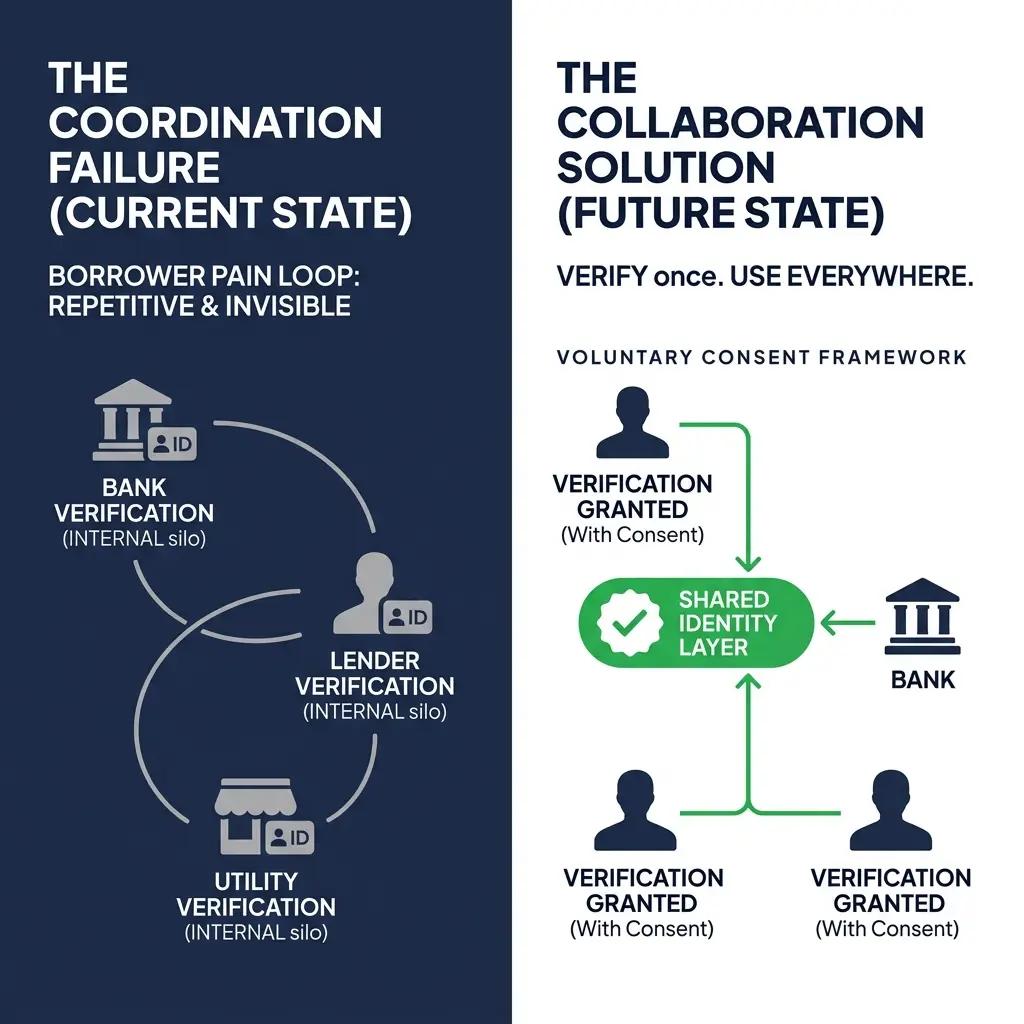
I've watched commercial finance struggle with identity verification for three decades. The same painful loop: borrowers submit documents, lenders request more documents, brokers chase both parties, and everyone pretends this is how it has to work.
Now, UK Finance and several major banks are building a voluntary digital verification service. The announcement positions it as a fraud-fighting tool wrapped in customer convenience. But the real story sits in what they're not saying directly.
(Source: UK Finance press release)
This isn't just about making online banking safer. It's about who controls the infrastructure of trust in the digital economy.
The Coordination Problem Nobody Wants to Name
Every business that needs to verify identity has built its own system. Banks have one approach. Lenders have another. Utility providers have a third. Government services have seventeen.
You prove who you are dozens of times a year to organisations that already have proof you exist. The inefficiency isn't accidental. It's structural.
The digital verification service UK Finance is developing attempts to solve this through a centralised infrastructure. Banks already hold verified identity data. They already have secure authentication systems. The proposal: let other organisations tap into that verification without rebuilding the entire stack.
Sounds sensible. But it requires something the financial sector struggles with.
Collaboration without competitive advantage.
Banks don't naturally share infrastructure that could become a strategic asset. The fact that multiple institutions are working together on this signals that something has shifted. The cost of fragmentation finally exceeded the value of proprietary control.
Fraud Is the Catalyst, But Not the Destination
The press release leads with fraud prevention. That makes sense. Fraud creates urgency. It justifies investment. It gives regulators a reason to pay attention.
But fraud is the catalyst, not the destination.
The actual infrastructure being built solves a broader problem: digital identity has no standard verification layer. Every transaction that requires proof of identity reinvents the wheel. That creates friction. Friction creates abandonment. Abandonment creates lost revenue.
I've seen this pattern in commercial finance. A qualified borrower applies for funding. The lender requests documents. The borrower submits outdated formats. The lender requests updated documents. The borrower gets frustrated and stops responding. The deal dies.
Not because the borrower wasn't creditworthy. Because the verification process exhausted their patience before the lender could make a decision.
The digital verification service addresses this by creating a reusable identity layer. You verify once. Other organisations access that verification with your consent. The friction point disappears.
That's not a fraud solution. That's an infrastructure upgrade.
The Consent Framework Is the Actual Innovation
Most coverage focuses on the technology. Secure authentication. Encrypted data transfer. Interoperability between systems.
The actual innovation sits in the consent framework.
This service is voluntary. You choose whether to participate. You control which organisations can access your verified identity. You can revoke that access at any time.
That's not standard practice in digital identity systems. Most operate on implied consent or regulatory mandate. You participate because you have to, not because you chose to.
The voluntary model creates a different dynamic. If the service doesn't deliver value, people won't use it. If it creates more friction than it removes, adoption stalls. The banks building this have to make it genuinely useful, or it fails.
That constraint changes the design. You can't hide poor user experience behind regulatory requirements. You can't force adoption through market dominance. The service succeeds only if it's better than the fragmented mess it's replacing.
I've spent four years building technology in an industry that resists change. FundingSearch provides commercial lending software that helps brokers and lenders work more efficiently. The lesson I learned: voluntary adoption is the only adoption that scales. Mandated solutions get compliance. Useful solutions get momentum.
Who Becomes the Custodian of Digital Identity?
The press release doesn't dwell on this question. But it's the question that matters most.
By positioning banks as the verification layer for digital identity, this initiative expands their role beyond financial services. You're not just trusting them with your money. You're trusting them with the proof that you exist.
That's a significant shift.
Banks already hold verified identity data. They already authenticate customers millions of times a day. The infrastructure exists. Extending it to serve other sectors isn't a technical leap. It's a strategic repositioning.
The alternative would be a government-run digital identity system. Several countries tried that. Most struggled with adoption, privacy concerns, or both. The UK's own attempts at centralised identity infrastructure didn't exactly inspire confidence.
The bank-led approach sidesteps those problems. People already trust banks with sensitive data. The regulatory framework already exists. The security standards are mature. You're not asking people to trust a new entity. You're asking them to extend trust they already granted.
But it also concentrates power.
If banks become the default custodians of digital identity, they control access to the digital economy. That creates dependencies. It creates gatekeeping potential. It creates questions about who gets verified and who doesn't.
The voluntary framework mitigates some of that risk. You can choose not to participate. But if the service becomes the standard verification method, opting out means accepting higher friction everywhere else.
That's not coercion. But it's not exactly a choice either.
The Interoperability Bet
The service only works if it's interoperable. A verification system that only works with one bank or one sector doesn't solve the coordination problem. It just creates another silo.
UK Finance is positioning this as an industry-wide initiative. Multiple banks participating. Multiple sectors are potential users. The goal is a shared infrastructure layer, not a competitive product.
That's harder than it sounds.
Banks compete. They have different technology stacks, different risk appetites, and different customer bases. Getting them to agree on shared standards requires aligning incentives that don't naturally align.
The fact that this initiative exists suggests those incentives have shifted. The cost of maintaining separate verification systems exceeded the competitive advantage they provided. Collaboration became the rational choice.
I've seen similar dynamics in commercial finance. Lenders resist sharing data because they view it as competitive intelligence. But the cost of operating in isolation creates inefficiencies that hurt everyone. The rational move is collaboration. The cultural barrier is mistrust.
UK Finance is betting that the financial sector has reached the point where collaboration makes more sense than competition. If that bet pays off, the interoperability problem solves itself. If it doesn't, the service fragments into competing standards, and we're back where we started.
What This Means for Businesses Outside Banking
If you run a business that verifies customer identity, this matters.
Right now, you probably use a combination of document checks, database lookups, and third-party verification services. Each method has costs. Each method has failure rates. Each method creates friction.
A standardised digital verification service changes that equation. Instead of building your own verification stack, you tap into existing bank infrastructure. The customer verifies once. You access that verification with their consent. The friction drops. The cost drops. The failure rate drops.
That's the promise.
The reality depends on adoption rates, integration complexity, and whether the service actually delivers lower friction than current methods. Early adopters will test those assumptions. If the service works, adoption accelerates. If it doesn't, businesses stick with existing solutions.
I've built technology that depends on network effects. The hardest part isn't the technology. It's reaching the threshold where momentum becomes inevitable. You need enough participants that the value of joining exceeds the cost of integrating.
UK Finance is trying to engineer that threshold by starting with major banks and high-value use cases. If they can demonstrate clear value in specific sectors, adoption spreads. If they can't, the service becomes another well-intentioned initiative that never reached critical mass.
The Timing Isn't Accidental
This announcement arrives as digital fraud rates climb and regulatory pressure on identity verification intensifies. That's not a coincidence.
The financial sector responds to pressure. Fraud creates pressure. Regulation creates pressure. Customer frustration creates pressure. When those pressures align, infrastructure projects that seemed too complex or too expensive suddenly become viable.
The digital verification service addresses all three pressure points. It reduces fraud exposure. It helps banks meet regulatory requirements. It improves customer experience. That alignment creates the political capital needed to push through an industry-wide initiative.
But timing also reveals urgency.
If banks wait too long, someone else builds the infrastructure. Tech companies already operate identity verification services. Government agencies keep trying to build digital identity systems. Fintech startups keep launching verification tools.
The bank-led approach only works if banks move before the market consolidates around alternative solutions. This initiative is a claim on territory that's still contested.
What Happens When Verification Becomes Invisible
The end state isn't a better verification process. It's the absence of a visible verification process.
You don't think about proving your identity. You just access services. The verification happens in the background. The friction disappears.
That's the actual goal. Not faster document checks. Not more secure authentication. The complete elimination of identity verification as a conscious user action.
We're not there yet. The voluntary digital verification service is a step toward that end state, not the arrival point. But the direction is clear.
I've spent three decades watching qualified businesses fail to access capital because verification processes created more friction than value. The funding gap isn't always about creditworthiness. Sometimes it's about patience. The borrower runs out of patience before the lender finishes verifying.
Infrastructure that makes verification invisible changes that dynamic. Deals that would have died in the verification phase are complete. Borrowers who would have abandoned applications stay engaged. Lenders who would have declined due to incomplete documentation make informed decisions.
That's not a marginal improvement. That's a structural shift in how transactions happen.
The Honest Truth About What This Solves
The digital verification service doesn't solve fraud. Fraud adapts. It doesn't solve privacy concerns. Privacy requires ongoing governance, not one-time architecture. It doesn't solve the trust deficit between institutions and customers.
What it solves is coordination failure.
Right now, every organisation that needs to verify identity operates independently. They duplicate effort. They create redundant friction. They make customers prove the same facts repeatedly to different parties who don't talk to each other.
That's not a technology problem. That's a coordination problem.
The digital verification service creates shared infrastructure where none existed. It doesn't eliminate the need for verification. It eliminates the need for redundant verification. That's a smaller claim than the press release suggests, but it's the claim that actually matters.
If you've ever applied for a mortgage, opened a business bank account, or tried to prove your address to a utility company, you've experienced this coordination failure firsthand. You know you're trustworthy. The organisation requesting verification doesn't. So you prove it. Again. And again. And again.
The service being built doesn't ask you to trust banks more. It asks them to trust each other's verification. That's a different kind of infrastructure problem, and it's the one worth solving.
I don't know if this particular initiative succeeds. Voluntary industry collaboration has a mixed track record. But the problem it's addressing is real, the timing is rational, and the approach is more structurally sound than previous attempts.
That doesn't guarantee success. But it makes success possible. And in an industry that resists change as effectively as financial services, possible is further than most initiatives get.