

All Posts
Best Business Loan Origination Platform Software Platforms Compared 2026
Published on 6 August 2026
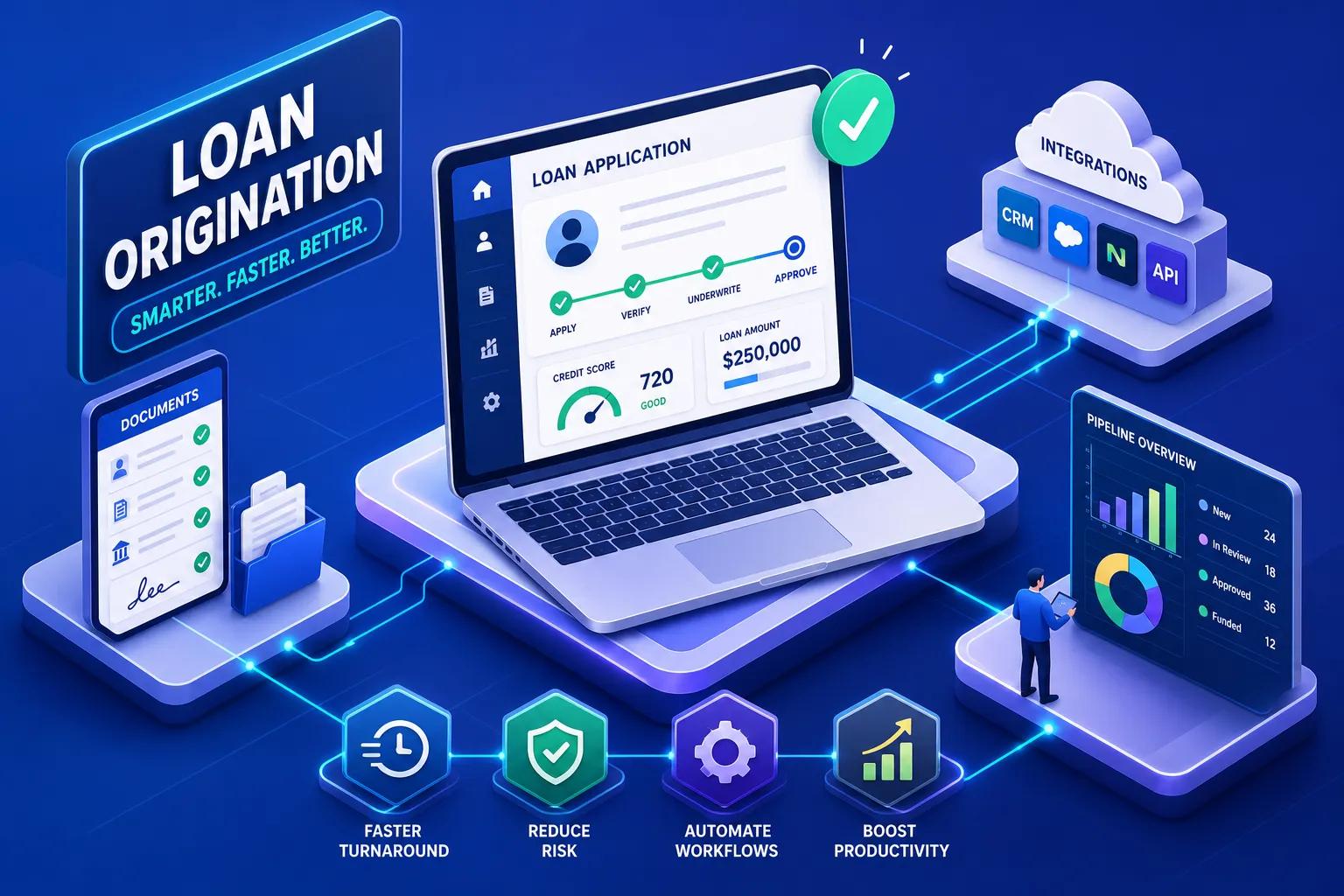
A business loan origination platform is a digital software system that helps commercial lenders source, pre-qualify, and submit applications faster by combining workflow automation, verified financial data, open finance integrations, and increasingly AI-driven decisioning. For UK commercial lenders, alternative finance providers, finance brokers, and professional advisers such as accountants working in SME lending, that matters because many legacy loan origination systems were built for a world of sequential paper-based workflows, manual data entry, and broker submissions that rely on phone calls and spreadsheets. Those platforms increasingly struggle to deliver the deal quality, integration depth, and time-to-decision that modern commercial lending operations actually require.
The market has also expanded significantly, which makes procurement harder rather than easier. There are now dozens of vendors claiming AI automation, open integrations, and faster decisions, so shortlisting the right three or four requires a structured framework rather than a G2 ranking. This guide does that by breaking down the evaluation criteria that matter in 2026, including automation and integration ecosystems, deal flow quality, pricing and implementation expectations, compliance requirements, and the leading commercial lending and loan origination platforms by lender type. FundingSearch is reviewed as part of that landscape, specifically for UK SME commercial lenders who need capabilities the traditional LOS market often does not offer, including verified data, pre-qualification, and smarter lender matching.
What to look for in a commercial lending platform in 2026
The right loan origination solution depends heavily on your lender type, product vertical, and deal volume. Using the wrong evaluation criteria leads to expensive procurement mistakes: lenders who buy enterprise servicing platforms when they need deal sourcing infrastructure, or brokers who adopt CRM tools when they need structured submission workflows. Before issuing an RFP or requesting a demo, assess every candidate against three core capability pillars.
Automation depth and AI-driven decisioning
Meaningful automation in a 2026 lending platform means rules-based routing, AI credit scoring, automated decisioning, and workflow automation across the loan origination process that genuinely reduces manual underwriting touchpoints and supports better decision making. The distinction that matters is between neural-network scoring that incorporates alternative data inputs and basic rules engines that vendors market as AI. Stronger AI-driven decisioning, often using machine learning for risk analysis, improves accuracy in credit evaluations and can reduce approval times to under 24 hours in suitable cases, enabling smarter lending decisions. Platforms like TurnKey Lender use neural-network decisioning with configurable workflow logic; others apply simple threshold rules dressed in AI language. Ask vendors specifically how their decisioning engine handles edge cases and what data inputs it draws on beyond bureau scores.
Integration ecosystem and data connectivity
The integration categories that matter most are core banking systems, CRM platforms (Salesforce, HubSpot), e-signature tools such as DocuSign, open-finance or accounting-software APIs, and Credit Bureaus, with connected integrations supporting the lending process through modern LOS platforms that provide real time visibility via real-time data exchange instead of leaving teams in disconnected systems. Enterprise LOS vendors typically offer prebuilt partner marketplaces with standardised connectors and APIs for seamless integration with third-party services; API-first platforms offer more flexibility and can streamline processes, but require more implementation effort and technical resource during deployment. For UK SME lending specifically, Companies House integration and accounting software connectivity (Xero, Sage, FreshBooks) are practical differentiators that separate platforms built for the UK market from those ported across from US commercial lending contexts, and integrations with Xero and Sage help financial data collection and verification while reducing manual data entry errors.
Deal flow quality and time-to-decision metrics
Application volume means little without pre-qualification quality, and better application quality also improves decision-making because underwriters get real time visibility into the file sooner. When verified financial data reaches underwriting teams before they review a deal, time-to-decision compresses and rework drops sharply. User-friendly digital experiences such as portals for loan applications, document uploads, and status tracking improve customer engagement and help lenders meet customer expectations. Digital lending software in the UK is currently delivering decisions within minutes to a few hours for automated cases, and within one to two working days for established limited companies with complete filed accounts. This is the dimension where traditional LOS tools and dedicated origination infrastructure platforms diverge most sharply, and it is where procurement decisions are most commonly made on the wrong basis.
The leading loan origination software platforms reviewed
The LOS vendor landscape breaks cleanly into three categories. Matching your lender type to the right category saves considerable time during procurement and avoids evaluating platforms that were never designed for your use case, and UK lenders should prioritise commercial lending software that delivers pre-qualified deal flow rather than generic loan management tools.
Enterprise and bank-grade origination systems for financial institutions
nCino is Salesforce-native and offers strong commercial lending workflow management, rules-based decisioning, and deep integration with the Salesforce ecosystem. Finastra serves large and global institutions with a broad enterprise banking suite that covers lending operations, risk, and reporting; these platforms typically support the entire loan lifecycle, not just origination, helping financial institutions reduce operational complexity across the loan lifecycle. MeridianLink is cloud-native and favoured by banks and credit unions, including community financial institutions, for its consumer-to-commercial workflow tools; these systems also integrate with core banking systems and often include compliance tools with automated compliance checks such as KYC and AML to support regulatory standards and reduce regulatory risks. All three are capable platforms with mature compliance postures and broad integrations. Their limitations are consistent: implementation timelines run six to eighteen months for complex deployments, total cost of ownership is material, and the commercial lending focus is predominantly US-centric, which creates friction for UK SME lenders dealing with UK-specific data sources and regulatory requirements.
API-first and fintech-native lending platforms
LoanPro is composable and suits fintechs, neobanks, and BNPL providers that need commercial loan origination in one business loan origination platform across the full process from application to funding. TurnKey Lender offers end-to-end automation with neural-network decisioning and alternative-data scoring across the full lending lifecycle, helping lenders streamline operations, improve operational efficiency, and support higher application volumes without proportional staff growth. DigiFi takes an embedded-lending orientation with configurable decisioning components for modern product builds and supports multiple lending products. Some advanced platforms in this category use automated decisioning to improve processing efficiency, with some lenders automating up to 48% of decisions for a commercial loan, and UK-specific options now include loan origination marketplace infrastructure that lets brokers submit a single enquiry to surface multiple live lender offers. These platforms suit lenders building bespoke products or needing flexible architecture, but they require more technical resource during implementation than enterprise solutions with prebuilt connectors.
Mortgage origination software and residential-focused tools
Encompass by ICE Mortgage Technology is the industry-standard mortgage LOS with strong workflow automation and loan file management. Blend offers a borrower-facing digital front end with AI-assisted review for mortgage and consumer lending. Both are purpose-built for residential mortgage rather than commercial or SME lending, which is why many UK brokers look for finance broker software to rival mortgage advisers when they modernise their commercial workflows. Commercial lenders should treat them as adjacent context rather than primary options: they are well-built within their category, but that category is not UK SME commercial finance.
FundingSearch: the UK SME origination infrastructure built differently
The gap identified above, purpose-built deal sourcing and pre-qualification for UK commercial lending, is precisely what FundingSearch addresses. It is not another LOS. It operates as origination infrastructure: the layer upstream of loan management, focused specifically on pre-qualified deal flow, lender autonomy, and AI matching without the trade-offs of a network marketplace or aggregator model, reflecting the broader mission described in its UK business fintech SaaS platform overview.
AI-driven matching with no lock-in
FundingSearch uses AI matching to route deals to lenders based on custom credit appetite and eligibility rules, covering sector, geography, loan size, turnover, and credit profile, across an extensive range of data points. Contrast this with aggregator models that restrict lender relationships, share margins, or impose network dependencies on lenders wanting to retain direct borrower contact. According to FundingSearch, lenders retain 100% of direct relationships, pricing autonomy, and commission structures, with no network lock-in or margin-sharing, which aligns with its positioning as an AI-driven commercial funding network in the FundingSearch press kit. Verify the specific contractual terms during your due diligence process to confirm this applies to your arrangement.
Pre-qualified deal flow backed by verified financial data
FundingSearch's pre-qualification layer is designed to connect with Companies House, Xero, Sage, and FreshBooks so that it supports application intake and document collection, while document management centralizes and secures borrower paperwork and speeds up data capture before verified accounts reach underwriting teams. The practical consequence for underwriting teams is significant: third-party data validation integrates input from multiple external sources to validate borrower information, improve data consistency, and help centralized data management minimize processing errors and reduce manual effort, so they spend their time on credit decisions rather than data gathering, chasing documents, or validating information that should have arrived pre-verified. For a lender handling fifty or more SME applications per month, that shift in underwriting focus is material and reflects the same design principles emphasised in FundingSearch’s commercial finance broker software for the UK market. FundingSearch reports that this approach substantially reduces form-filling time and enables brokers to onboard clients more quickly, specific performance figures should be confirmed directly with the vendor during evaluation.
Why UK commercial lenders are switching to dedicated origination infrastructure
Enterprise LOS tools are built for loan servicing and handle post-origination work such as payment processing, while origination infrastructure supports the loan origination side of the lending process. They manage the lifecycle of a loan after origination. They do not solve the deal sourcing and pre-qualification problem that sits upstream, and dedicated infrastructure can help small business lenders streamline operations through workflow automation that routes applications and tracks statuses; the same logic applies to commercial finance broker software where brokers need origination-focused workflows rather than servicing tools. FundingSearch is not a replacement for a loan management platform; it is the layer designed to deliver pre-verified SME deal flow into existing underwriting workflows in a manner consistent with GDPR requirements. This is the gap the traditional vendor market leaves open, and it is why UK commercial lenders are separating their origination infrastructure from their loan management infrastructure rather than trying to solve both with a single enterprise system. For small business lending, dedicated operational workflows also reduce manual effort, support CFPB 1071 compliance data collection, strengthen risk management, and modernize credit operations.
Pricing models and total cost of ownership
Understanding cost structure before issuing an RFP avoids sticker shock during procurement and enables a genuinely like-for-like comparison across vendor categories.
SaaS, per-loan, and enterprise licensing: what each model means in practice
Per-user SaaS subscriptions for mid-market loan processing software typically run in the range of £40 to £150 per user per month, though published pricing varies and should be confirmed directly with vendors at current exchange rates. Per-loan fees range from around £5 to £25 for simpler products, rising to £25 to £100 or more per closed loan in mortgage-focused tools. Enterprise annual licences often start at £25,000 per year with implementation costs on top, and hybrid models combining subscription and per-loan components scale quickly with volume. The hybrid model can look attractively priced at low volumes but becomes materially more expensive as deal throughput increases.
Three-year TCO: what drives the real cost of a loan origination system
Implementation cost is the variable that most procurement teams underestimate, and implementation value should be judged partly by whether the platform can scale application volumes without proportional staff increases as application demand grows with your business needs. One-time setup fees for enterprise or heavily customised deployments frequently drive total cost beyond the headline licence fee within the first year. Integration work compounds this further. A custom-build three-year TCO is commonly estimated in the range of £1.5M to £4M when delivery risk, maintenance, and integration overhead are included, though figures vary by deployment scope and should be benchmarked against your specific requirements. Modern loan origination software typically improves accuracy and reduces processing times enough to affect three-year TCO materially, especially when multi-product brokers consolidate tools into a single finance sourcing software for brokers rather than juggling separate systems. Evaluate platforms on three-year TCO, not monthly price. Weight integration complexity heavily in that calculation, because it is the single largest driver of cost overrun in LOS deployments, with typical mid-market UK implementations running three to six months and complex enterprise programmes running twelve to eighteen months; providers that support long term success tend to manage this phase more predictably.
Compliance, security, and data protection requirements
For UK commercial lenders, compliance verification is non-negotiable during vendor due diligence. The three frameworks to assess are distinct in nature and require different evidence during procurement.
SOC 2 is an independent attestation report rather than a certification. Type II covers controls over a defined period, not a single point in time, which is why it carries more weight than Type I. ISO 27001 is a formal third-party certification issued by an accredited body, with ongoing surveillance audits that verify the information security management system remains effective. GDPR is a legal requirement, not a badge: vendors demonstrate compliance through Data Processing Addenda, subprocessor lists, Standard Contractual Clauses, and data residency documentation, and strong regulatory compliance also depends on systems that keep compliance features updated as laws change. A "GDPR compliant" badge without substantive contractual evidence is not sufficient and should be treated as a procurement risk signal. Better loan origination software automates compliance checks to support sound lending practices, maintains audit trails across the loan process, and helps reduce manual errors.
Auditability and what to request from vendors during due diligence
Request the following from every vendor before contracting: a SOC 2 Type II report (under NDA if required); an ISO 27001 certificate with surveillance audit history; a completed GDPR Data Processing Addendum with subprocessor list; data residency confirmation for UK borrower data; and a penetration test attestation. Reputable vendors maintain a trust centre or structured evidence package. Any vendor that cannot provide organised compliance documentation within a reasonable response window presents a procurement risk regardless of their feature set or commercial terms.
How to build your LOS shortlist and run the vendor evaluation
Moving from a long list to a shortlist of three or four genuinely suitable platforms requires a sequenced approach, not a feature comparison matrix.
A prioritised evaluation framework for commercial lenders
The following steps separate a reliable shortlist from an expensive mistake:
- Define your lender type and product vertical precisely. This alone eliminates most of the vendor market immediately.
- Map integration requirements against your existing tech stack before any demo. Integration complexity will determine implementation cost and timeline more than any other factor, so buyers should assess whether those connections support operational transparency and real-time visibility across the lending process.
- Set a three-year TCO ceiling before issuing RFPs so that commercially attractive headline pricing does not distort vendor selection.
- Require a live demo using your own deal type rather than vendor-selected scenarios, and score vendors on time-to-decision improvement as a first-order metric. That scorecard should also cover workflow automation that can route applications and track statuses, plus real-time analytics dashboards for approval rates and portfolio performance; in practice, success depends on how well the platform performs under live operating conditions.
- Reverse the weighting most lenders apply. Lenders consistently over-weight interface aesthetics and under-weight data integration quality during demos. Correct that and your shortlist will be more accurate.
- The right platform should streamline processes enough to lift productivity, with automated workflows often increasing productivity by 25%.
Key questions to ask every loan origination software vendor
These questions surface capability gaps that marketing materials will not reveal:
- How does the platform handle pre-qualification and verified borrower data before a lender reviews a deal?
- How does the platform centralize application intake, credit scoring, and credit analysis in a single loan process without relying on manual processes?
- What is the realistic implementation timeline for our lender type, product vertical, and current tech stack?
- Which external and third-party data sources are used for data verification and real-time credit assessments to support risk assessment?
- How does your pricing model scale with our projected deal volume over three years?
- What share of loan applications can be handled through automated underwriting and automated decision-making, what approval-time reduction is realistic for our use case, and how do market conditions affect interest rates, especially in specialised products such as bridging loan brokers & lenders?
- What compliance certifications and GDPR contractual documents can you provide now, not after contracting, particularly if you operate a borrower-facing business & commercial lending platform as well as lender-side infrastructure?
- For UK SME lenders specifically: does the platform integrate directly with Companies House and UK accounting software (Xero, Sage, FreshBooks)?
Any vendor that struggles to answer these questions directly in a first conversation is signalling that the implementation process will be similarly opaque.
Your next step in evaluating origination infrastructure
You now have the framework to shortlist with confidence: the three evaluation pillars that matter, the vendor landscape grouped by lender type, a realistic cost and implementation picture, the compliance evidence to demand, and a procurement sequence that surfaces gaps before you sign. The decision that remains is whether your current or planned loan origination system actually solves the deal sourcing and pre-qualification problem, or whether it manages loans that have already been originated elsewhere.
If you are comparing the best loan origination software in 2026, the infrastructure layer upstream of your LOS deserves equal scrutiny. For UK commercial lenders and brokers who need pre-qualified SME deal flow routed to their exact credit appetite, without network lock-in or margin-sharing, FundingSearch is the origination infrastructure built specifically for that purpose. The platform sits upstream of your loan management system, delivering verified financial data directly to your underwriting team so decisions happen faster and with less overhead. Explore FundingSearch to see how dedicated origination infrastructure compares to the digital lending software and LOS tools you are currently evaluating. View more about our SME Lending software here.