

All Posts
4 min read
Automated loan origination: a practical guide for lenders
Published on 6 August 2026
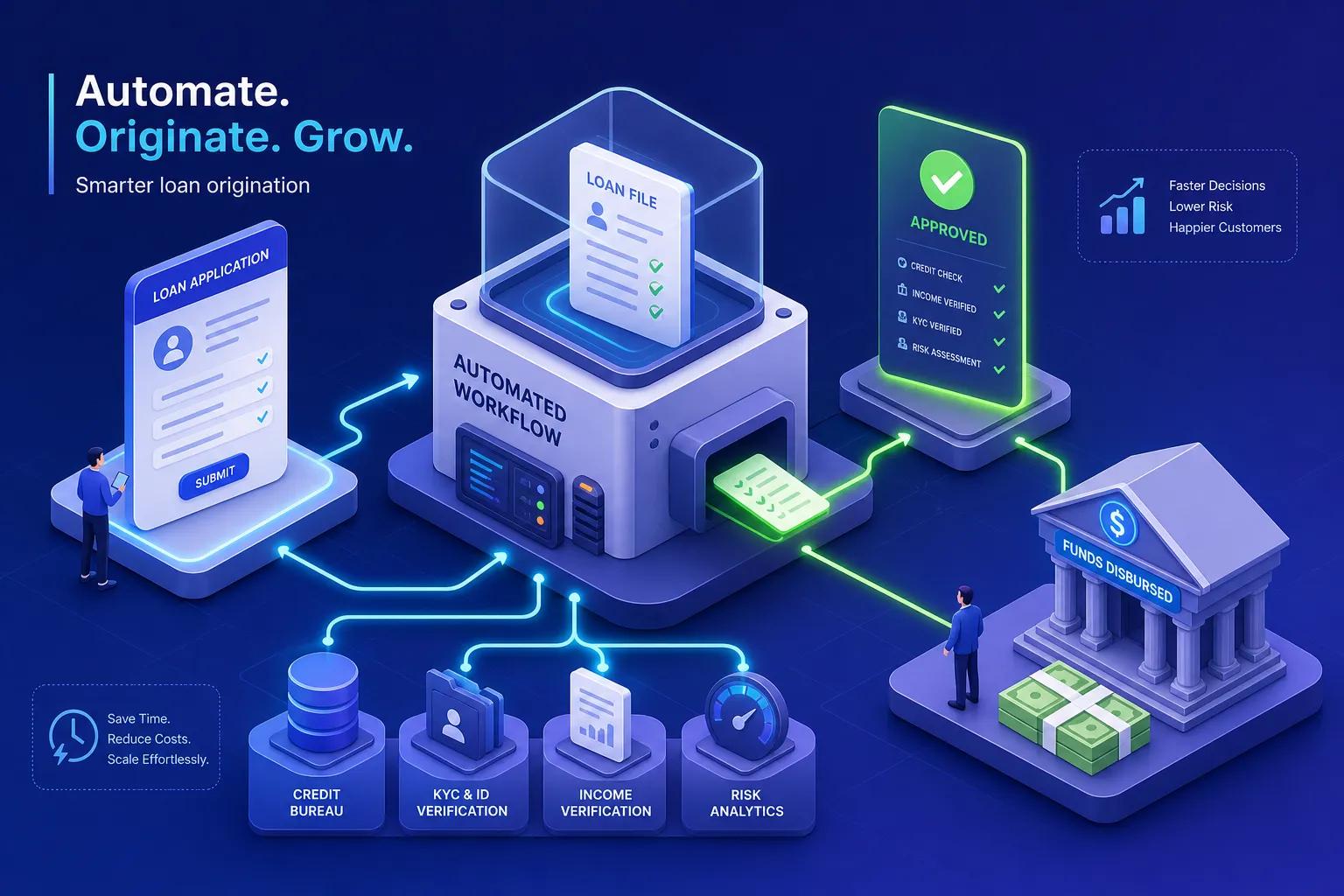
A commercial loan application that takes six weeks to process is a deal at risk. Automated loan origination addresses exactly this problem, replacing manual handoffs with structured, data-driven stages that run without unnecessary human intervention. Borrowers lose patience after the third document chase, and brokers move their clients to lenders who can respond in days. Underwriting teams spend their time gathering data that a well-built system could have verified automatically before the file ever reached them. The business case for automating the origination process is not theoretical: it is the difference between a funded deal and a lost one.
Automated loan origination is not a single feature you bolt onto an existing workflow. It is a complete rethinking of how an application moves from submission to decision. FundingSearch was built on this principle from the ground up. Companies House integration pulls verified company data in seconds, an AI-driven matching engine routes deals to lenders across 900+ data points, and brokers can complete a client submission in under ten minutes. That is what end-to-end automated loan processing looks like in the UK commercial market.
This guide covers how automated origination works mechanically, where manual processes fall short by comparison, the core components every origination system must include, the KPIs that prove ROI, a realistic implementation roadmap, and a framework for evaluating platforms worth deploying.
How automated loan origination works end to end
The origination pipeline is best understood as a sequence of discrete, automated handoffs rather than a series of manual tasks. The process begins the moment a borrower or broker submits an application and ends when a pre-qualified, data-verified deal lands in an underwriter's queue. Each stage feeds the next without human intervention unless a genuine exception warrants it.
Data ingestion and borrower pre-qualification
Modern digital lending platforms pull structured data directly from Companies House, open finance APIs, and accounting integrations, including Xero, Sage, and FreshBooks, to populate application fields automatically. The Companies House API alone eliminates the repetitive manual work of capturing company name, registered address, incorporation date, director details, and filing history. Pre-qualification then runs in real time: eligibility rules are applied against verified financial data before a human ever opens the file. The result is a pre-qualified application with verified financial data attached, not a raw submission waiting for an analyst to begin work. Automated loan origination delivers its most immediate time saving precisely at this stage.
AI-driven lender matching and deal routing
Once a borrower is pre-qualified, the decisioning layer matches the application to lenders whose credit appetite, sector preferences, loan size parameters, and geography filters align with the application profile. This is not a referral directory or a simple search function. It is a rules-based routing engine that eliminates mismatched submissions before they consume underwriting time. A lender focused on asset finance in the £250,000 to £2 million range in the Midlands never sees a hospitality invoice finance deal from Greater London: the system filters it before it arrives.
Underwriting handoff and disbursement
The underwriting team receives a structured file containing verified financial data, credit scoring outputs, compliance checks, and a matched lender recommendation. The underwriter's role at this stage is exception review, not data gathering. Once approved, the disbursement trigger fires and the deal passes cleanly to loan management or core banking. Every stage is logged, auditable, and traceable, which matters considerably when the FCA comes to review the decision.
Where manual origination falls short
Manual origination is not just slower. It introduces compounding risk at every stage where a human re-keys data, chases a missing document, or applies a credit rule inconsistently. Understanding the concrete cost of that risk is how lenders build the internal business case for automation.
The speed and cost gap
Industry benchmarking consistently shows that top-performing automated lenders achieve a cost per funded loan of £250 to £400, while manual operations typically exceed £600 per loan. AI-enabled origination workflows reduce cycle time from 45 to 60 days down to under 20 days, and straight-through processing delivers decisions in under 24 hours. For a mid-market UK commercial lender processing 200 deals per year, closing that cost gap represents a material improvement to margin. The deal volume uplift from faster cycle times compounds the return further still.
Data accuracy, drop-off, and compliance exposure
Manual data entry creates inconsistencies that surface late in the underwriting process, delaying decisions or triggering rejections on errors that were entirely correctable at the point of submission. Application drop-off compounds the problem: a borrower who has to upload the same document three times, or wait ten days for an eligibility response, will walk. Digital origination workflows typically see completion rates in the range of 30 to 40%, according to lender performance data gathered by UK fintech analysts, and even modest improvements to that figure carry a direct revenue effect. There is also a compliance dimension that lenders cannot ignore: manual audit trails are incomplete by their nature, and an FCA review of a manual decisioning process is a significant operational risk.
The core components every origination system must have
The architecture of a reliable origination system sits across three layers: front-end intake, middleware decisioning, and back-end integration. Understanding what belongs in each layer allows lenders to hold any vendor's product specification up to a meaningful checklist.
The decisioning and rules engine
The rules engine is the operational centre of the platform. It handles configurable credit rules, automated eligibility checks, approval and rejection routing, and exception escalation. The critical requirement is configurability: the lender's credit team must be able to adjust rules without requiring developer intervention. This is a common failure point with enterprise LOS platforms. When a credit team needs to change a minimum turnover threshold or add a sector exclusion and has to raise a development ticket to do it, the system is working against the business rather than for it.
Integration layer: Companies House, open finance, and accounting APIs
This is where the largest origination time savings are won or lost. A platform that ingests Companies House data, two to three years of verified accounts from accounting software, and open banking feeds eliminates the biggest manual data-gathering burden in commercial lending. API-first architecture matters here because it determines reliability, speed, and the ability to add integrations as the platform evolves. A platform built on flat-file imports and manual CSV exports is not an origination system: it is a digital filing cabinet.
Compliance, audit, and data governance
KYC and AML automation, GDPR-compliant data processing, audit-trail generation, and FCA-compliant explainability of automated decisions are not optional additions. Under the FCA's Consumer Duty and CONC 5.2A creditworthiness rules, a lender must demonstrate that automated decisions rest on sufficient, relevant data and that the resulting outcomes are fair and traceable. The architecture must embed compliance from the start, because retrofitting it after deployment is expensive, time-consuming, and never fully complete.
KPIs for automated loan origination and ROI benchmarks
Automation investment requires a business case that survives scrutiny from a credit committee or board. The following KPI framework gives lenders the measures, benchmarks, and calculation logic to build that case with confidence.
Cycle time and decision speed
Submission-to-decision time is the primary efficiency metric. The benchmark for straight-through processing is under 24 hours; end-to-end funded deals should fall within one to seven days. Measure your current manual baseline, then calculate the deal volume uplift that results from the time freed by automation. A reduction from a six-week cycle to a one-week cycle does not just save cost: it allows the same underwriting team to handle six times the volume without additional headcount.
Cost per funded loan and profit per loan
Calculate cost per funded loan by dividing total origination cost by the number of funded loans in a period. The benchmark for top performers sits at £250 to £400; laggards exceed £600. Layer in profit per loan as the complete ROI measure: total revenue minus total expense, divided by loans disbursed. This figure connects automation savings directly to financial return in a language credit committees understand. Application completion rate is the supporting metric: moving from 25% to 35% completion on the same volume of applications is a revenue gain that requires no additional marketing spend.
Approval quality and throughput
Speed gains are worthless if approval quality degrades alongside them. Track approval rate, early default rate, and exception volume as quality controls running in parallel with efficiency metrics. A well-configured rules engine improves both throughput and credit consistency simultaneously: it does not create a trade-off between the two. If your exception volume is rising as cycle time falls, the rules configuration needs attention.
A practical implementation roadmap for commercial lenders
Enterprise LOS deployments have a reputation for running over time and over budget. That reputation is earned, usually because lenders underestimate the integration and change-management phases. The following roadmap is structured to be realistic about where complexity accumulates and honest about what determines success.
Planning and discovery: months one and two
Requirements gathering, integration mapping, and stakeholder alignment are the unglamorous work that determines everything that follows. The quality of the discovery phase determines the quality of the configuration. Lenders who treat discovery as a formality spend months fixing problems that were entirely predictable from the outset. Map your current origination process step by step, identify where data is re-keyed, where decisions are inconsistent, and where drop-off occurs. That map becomes your configuration brief.
Configuration, integration, and testing: months three to eight
Platform configuration covers credit rules, product setup, and lender profiles. Integration development covers Companies House, accounting APIs, and credit bureau connections. QA testing phases should include functional, security, and performance scenarios using real case data. Cloud-native platforms with pre-built integrations compress this phase significantly compared to bespoke enterprise builds: what takes six months on a custom stack can take six weeks on a platform designed for UK commercial lending from the start.
Go-live, training, and optimisation: months nine to twelve
A phased rollout, beginning with one loan product or one channel, reduces operational risk and allows the team to prove integrations and credit controls before full cutover. Straightforward cloud implementations go live within six to twelve months; complex enterprise deployments with core banking integration extend to eighteen to twenty-four months. The right vendor shortens this timeline considerably, particularly when the platform is already configured for the UK regulatory environment rather than requiring a compliance retrofit from a US-built system.
What to look for when evaluating an origination platform
The market for loan origination platforms is broad. Large US-built enterprise systems such as Encompass, nCino, and Finastra dominate by brand recognition, but they were designed for the US mortgage and commercial banking markets and require significant compliance customisation to meet UK regulatory expectations. That customisation is a cost and a risk that is easy to underestimate at procurement stage.
Must-have technical criteria
The non-negotiables for any platform you shortlist are:
- Configurable rules engine operable by the credit team without developer involvement
- API-first architecture with pre-builtCompanies House and accounting software integrations
- GDPR-compliant data handling with full end-to-end audit trail
- Lender autonomy over credit profile, pricing, and commission structure
- Demonstrated decision explainability for FCA review purposes
Each of these criteria has a specific failure mode when absent. Without a configurable rules engine, the credit team cannot respond to market conditions without engineering support. Without API-first architecture, integrations are brittle and expensive to maintain. Without lender autonomy, the platform becomes a network that extracts margin from every deal you place.
UK regulatory alignment
FCA requirements covering creditworthiness and affordability assessment under CONC 5.2A, Consumer Duty obligations under PRIN 2A, explainability of automated decisions, and operational resilience standards under SYSC are non-negotiable and non-transferable. A platform built for SBA lending or US mortgage origination does not arrive with these obligations satisfied. Assess every vendor on UK regulatory fit specifically, not on general compliance marketing language.
FundingSearch as purpose-built UK origination infrastructure
FundingSearch was designed specifically for UK limited company SME lending. It arrives ready for the UK regulatory environment, without network lock-in or the configuration overhead that comes with adapting a platform built for a different market. AI-driven matching across 900+ data points routes deals to lenders whose credit appetite, geography, sector, and loan size parameters match the borrower profile precisely. Companies House and accounting software integrations reduce form-filling time by up to 80%, and brokers complete client submissions in under ten minutes.
The pure infrastructure model preserves full lender autonomy over pricing, relationships, and commission structure. There is no margin-sharing arrangement, no dependency on a proprietary network, and no restriction on direct lender-borrower relationships. Unlike generalist aggregators that prioritise volume over match quality, or large enterprise platforms that prioritise global scalability over UK regulatory fit, FundingSearch delivers pre-qualified deal flow with verified financial data directly to underwriting teams, which is the outcome the automated loan origination investment is supposed to produce.
The case for acting now
Automated loan origination is not a marginal efficiency improvement. It is the foundation of a scalable, compliant, and commercially competitive lending operation. UK lenders that have already closed the gap on cycle time, cost per loan, and data accuracy are capturing disproportionate deal flow as the SME lending market continues its shift toward digital-first origination. According to UK Finance data, that shift has accelerated materially since 2023, and the performance differential between automated and manual operations is now measurable in commercial terms rather than theoretical ones.
The most productive next step is straightforward. Map your current origination process against the KPI benchmarks set out here, identify where cost and time losses are concentrated, and use the technical and compliance criteria above to build a vendor shortlist grounded in UK-specific fit rather than global brand recognition. Pressure-test each platform against real integration requirements, real compliance obligations, and real deal flow volumes before committing.
To see how end-to-end automated loan origination works in practice for UK commercial lending, explore what FundingSearch delivers across the full origination pipeline. The infrastructure is ready: the question is whether your current process is costing you more than you realise.