
All Posts
6 min read
Loan to Buy a Company: How to Finance an Existing Business Acquisition
Published on 27 August 2026

If you want to buy a business rather than build one from scratch, you will almost certainly need external finance. This guide gives you a comprehensive look at how a loan to buy a company works in the UK, what lenders expect, and how to structure a deal that actually gets approved.
Quick overview: How a loan to buy a company works
In 2026, buyers can use a business acquisition loan to purchase an existing business or franchise in the UK. Market conditions matter: the Bank Rate sits around 3.75%, funding margins are elevated, and lenders apply tighter underwriting standards than they did a few years ago. That means preparation is everything.
A loan to buy a company is straightforward in concept. Instead of launching a new business with uncertain revenue, you acquire an established business that already has customers, staff, and cash flow. Business acquisition loans provide a lump sum that typically covers the purchase price and related costs, repaid over an agreed term from the company's earnings. Commercial acquisition loans are offered by banks and commercial lenders, with terms shaped by the specific deal.
Simple example: Suppose you want to buy a profitable company in Sheffield valued at £500,000. A lender may require a 30% deposit (£150,000), financing the remaining £350,000 over six years at roughly 8% interest. Monthly repayments would land around £6,000–£7,000, all serviced by the target business's cash flow.
The lender assesses three things before approving: the target company's historic financial statements, your experience as the incoming buyer, and the structure of the business purchase itself.
| Parameter | Typical UK Range (2026) |
|---|---|
| Loan amount | £50,000–£10m+ depending on deal |
| Deposit (equity) | 20–40% of purchase price |
| Term | 3–7 years (up to 10 with property) |
| Security | Business assets, property, personal guarantee |
| Interest rates | 7–12% p.a. for SME deals |
| Buyers are typically expected to inject 10% to 20% of the total acquisition cost at minimum, though UK lenders for SME deals often ask for 20–40%. |

Why use a loan to buy an existing business?
Buying an established business gives you immediate revenue, loyal customers, and operational systems that would take years to build from scratch. In a 2026 economy marked by uncertainty, this proven foundation makes financing far easier to secure than money for a start-up with no track record.
Key advantages of using a loan for a business acquisition:
- You gain immediate cash flow from existing contracts and sales, rather than burning capital during a ramp-up phase.
- Brand recognition and an established supply chain lower your marketing and operational risk as the new owner.
- Existing staff, equipment, and intellectual property transfer with the business, reducing setup costs.
- A loan preserves your personal assets and spreads the cost of the business purchase over time, rather than requiring a lump sum upfront.
- Equity financing alongside debt helps reduce the overall debt burden when acquiring a business.
- Lenders prefer funding a target business with 2–3 years of filed accounts over a pure start-up, because stable revenue reduces risk.
A company acquisition requires a blend of capital sources. Valuation is crucial to ensure the purchase price is justified based on cash flow, not just the seller's asking figure. Common use cases include a management buyout of a family-owned firm, a franchise resale, or buying a competitor to consolidate a local market.
Types of business acquisition loans you can use
Different loan types suit different deal sizes and risk profiles. Here are the main options for financing a business purchase in the UK:
- Term business loans: The core product for most acquisitions. Business loans from banks or alternative lenders typically run 3–7 years, with fixed or variable interest, secured on business assets. Traditional bank loans offer competitive rates but stricter criteria; alternative financing from specialist lenders provides more flexible financing for complex deals.
- Asset-based lending (ABL): ABL uses the target company's own assets as collateral - receivables, stock, equipment, or other assets. Asset finance facilities can fund a portion of the deal based on tangible asset values within the business.
- Commercial mortgages: When freehold property forms a significant part of the acquisition value, commercial mortgages can finance the property component of the business acquisition, often at lower rates over longer terms.
- Bridging finance: Bridge loans are short-term loans for quick business purchases where timing is tight. Bridging loans are later refinanced into longer-term business loans once permanent funding is arranged, and buyers should understand how short-term property and business bridging finance is typically structured and priced.
- Seller financing and vendor loan notes: Seller financing allows buyers to pay the seller over time, typically filling 5–20% of the purchase price. Vendor financing allows payment to the seller over time using future profits, reducing the external loan needed. Vendor loan notes are subordinated behind senior debt.
- Mezzanine financing: Mezzanine financing is a hybrid of debt and equity financing. It combines senior debt and equity characteristics, carrying higher interest rates (often 10–20%+), but can bridge a gap when senior debt and buyer equity fall short.
- Leveraged buyouts (LBOs): An LBO involves using borrowed money to fund the acquisition, with the target company's assets and cash flow securing the debt.
- Government-backed loans: Government-backed loans offer flexible eligibility and longer terms. In the US, SBA loans can provide up to $5 million for business acquisitions. SBA loans can also provide up to $5 million for acquisitions, though SBA guarantees come with specific eligibility criteria and SBA loans can take weeks to close after application submission.
What lenders look for when you buy a business
Lenders have rigorous evaluation processes for potential borrowers and target businesses. Their criteria apply to both you and the company you want to acquire.
Checks on the target business:
- At least 2–3 years of filed accounts showing stable or growing revenue
- Predictable cash flow and strong cash conversion
- Lenders review revenue, profits, and cash flow from financial statements to establish maintainable earnings
- Low customer concentration - no over-reliance on one or two clients
- No major pending litigation, tax disputes, or regulatory problems
- Expect lenders to confirm the purchase price matches market value through independent assessment
Financial tests:
- Lenders evaluate the Debt Service Coverage Ratio (DSCR) before granting loans, stress-testing repayments against downside scenarios
- Debt serviceability ensures the target company's cash flow covers loan repayments comfortably
- Typical leverage: 2.5× to 4× adjusted EBITDA for SME deals
Personal factors:
- Lenders prefer buyers with relevant management or operational experience
- Lenders check your credit score and financial health - but they check your overall financial health, not just your credit score
- A clean personal credit history is crucial for securing acquisition financing
- The more equity you invest, the better your loan terms; collateral is often required to secure business acquisition loans
- Security typically includes debentures over company assets, a personal guarantee from directors, and sometimes charges over property
A solid business plan is essential for loan approval. Without one, even strong financials won't get you past credit committee.
Step-by-step: How to get a loan to buy a company
Here is a practical, chronological process from initial idea through to funding:
- Identify the target business: Review headline financials - turnover, profit, EBITDA - and sanity-check the valuation against comparable sales in the sector. Research the market thoroughly before committing money.
- Prepare your solid business plan and acquisition case: Build financial projections covering at least 3–5 years, with monthly forecasts for the first 36 months. A strong financing package includes a detailed acquisition plan and financial projections showing how debt repayments, working capital needs, and capital expenditure will be managed from cash flow.
- Assemble documentation: You typically need to submit personal and business financial documents. Collect the last 3 years' statutory accounts, recent management accounts, aged debtor/creditor lists, bank statements, an asset register, and heads of terms for the business purchase.
- Structure the deal: Determine your equity contribution, negotiate any vendor finance or deferred consideration, and decide between senior debt, mezzanine, or blended solutions. A solid business plan is essential for securing a business loan at this stage.
- Approach lenders or use a platform: Submit applications to relevant lenders or use a matching platform to shortlist options. Pass initial screening, undergo credit assessment, receive an offer of finance, complete legal due diligence, then proceed to drawdown.
Standard timeframes run 4–12 weeks from full application to completion for straightforward SME deals. Property-heavy or complex acquisitions take longer, especially where you are combining acquisition finance with separate UK business loan facilities for working capital or growth.

Structuring the deal: deposits, loan terms and security
How you structure the business acquisition directly affects what lenders will offer. Getting the structure right can be the difference between approval and rejection.
- Buyer equity: Typically 20–40% of the purchase price in cash or assets. Lenders typically expect a down payment of about 10% of the purchase price at the low end, but UK SME deals usually require more. Lower deposits may work when strong mitigants exist (vendor finance, high collateral, recurring revenue).
- Loan terms: Senior debt amortises over 3–7 years for most acquisitions, extending to 10 years where property is involved. Financing terms should be thoroughly understood including interest rates, arrangement fees (1–3%), early repayment charges, and financial covenants.
- Fixed vs variable rates: Fixed rates protect against rising interest; variable rates (SONIA + margin) may start lower but carry risk if rates climb further.
- Security: Debenture over the acquired company, fixed charges over property or key assets, personal guarantees, and cross-collateralisation with other group companies where relevant.
- Negotiating goodwill can affect the overall purchase price - ensure any goodwill premium is justified by maintainable earnings, not just the seller's sentiment.
Worked example: A £750,000 acquisition might split as follows - buyer equity of £225,000 (30%), senior debt of £450,000 (60%), and vendor finance of £75,000 (10%) repayable over 24–36 months. The senior debt repays over five years at 8–10% interest plus fees, with a debenture and personal guarantee as security.
Due diligence on the existing business before you borrow
Your due diligence should be at least as robust as the lender's. Due diligence verifies the business's financial health before purchase and directly strengthens your position when negotiating price, loan terms, and security.
Financial checks:
- Revenue trends, gross margin stability, profitability, and seasonality over 3–5 years
- Cash conversion: how much profit actually turns into accessible working capital after tax, interest, and capital expenditure
- Review financial statements for hidden liabilities - VAT arrears, pension deficits, lease obligations
Operational and commercial checks: Buyers acquiring land-rich or development-focused businesses should pay close attention to how existing sites are financed, including any bridging loans for land and development finance that may need refinancing post-completion.
- Customer concentration and contract expiry dates for the business's key customers
- Supplier dependence and employee stability (key personnel risk)
- Condition of equipment and other assets
Legal and compliance:
- Outstanding litigation, regulatory approvals, intellectual property ownership, and lease terms
- Verify that licences needed to run the business are transferable to the new owner
Integration strategies are critical for post-acquisition success. Plan how you will manage the transition before you sign anything - not after.
Where FundingSearch fits in: matching you with lenders for business acquisitions
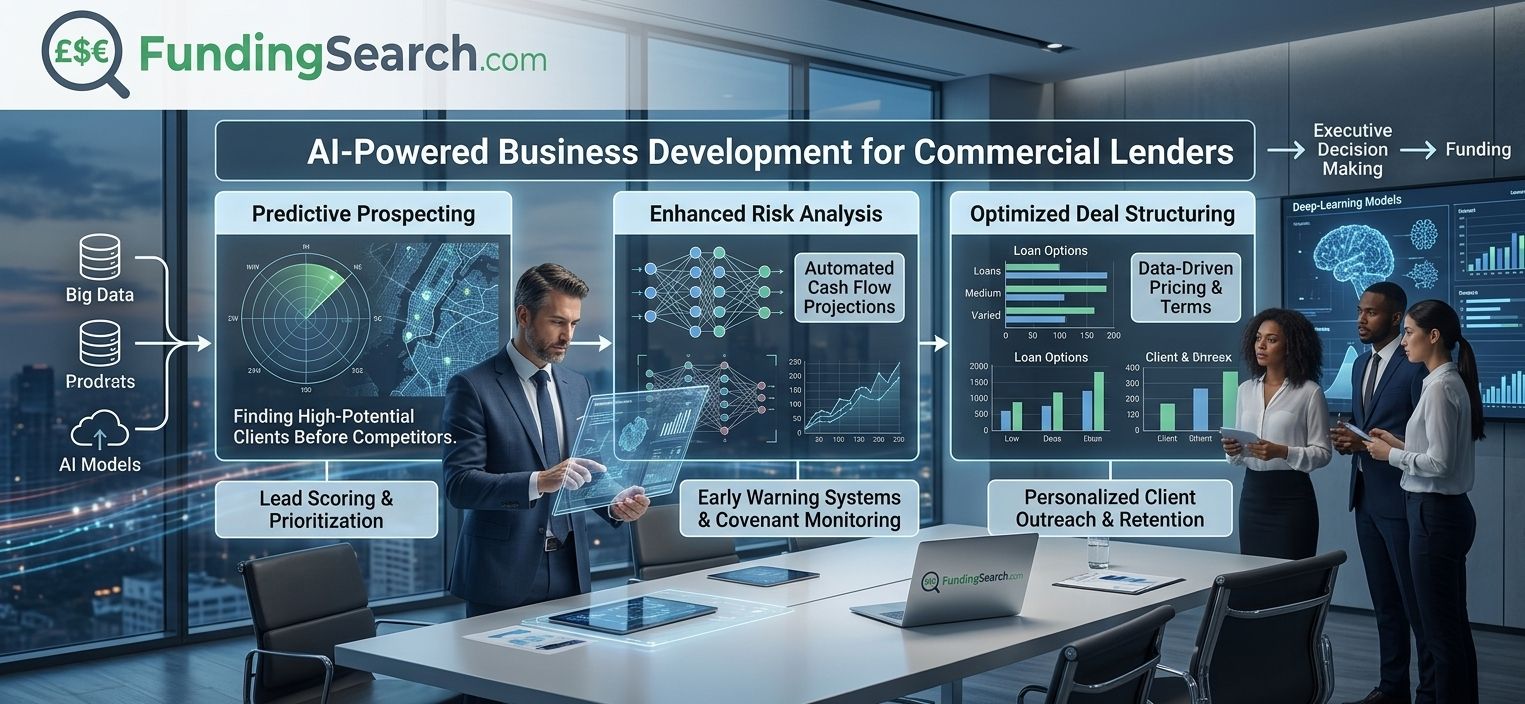
FundingSearch is a UK B2B fintech marketplace launched in 2025, built to connect limited-company borrowers with commercial lenders and brokers across multiple finance asset classes, acting as an SME lending deal-origination platform rather than a single direct lender.
Buyers of an existing business can use the platform to source flexible business and commercial funding options, business acquisition loans, commercial mortgages, bridging finance, invoice finance, and asset-based lending in one place. The AI-driven lender matching engine pulls verified financial data from Companies House, Xero, and Sage, giving lenders confidence in the numbers and saving you weeks of manual document chasing, while the underlying commercial finance broker software streamlines packaging and submission for intermediaries.
Typical workflow: Upload target company details and accounts, define the business purchase structure and your financial situation, let the system shortlist suitable lenders, then collaborate online with your chosen partner - whether that is a broker or a direct lender - using a loan-origination marketplace that surfaces multiple lender offers from a single enquiry. The platform is free or low-cost for SME borrowers, with subscription fees paid by lenders and brokers seeking pre-qualified acquisition deals.
If you are looking to access multiple funding solutions, compare loan terms side by side, and improve your chances of securing the right loan to buy a company on the right terms, FundingSearch is the place to start. This general information applies whether you plan to invest in a small business or pursue a larger mid-market deal.
Getting the right finance to buy a company starts with preparation, the right deal structure, and the right lender match. Upload your details to FundingSearch and let the platform do the heavy lifting.