

All Posts
4 min read
Invoice Loans: How to Turn Unpaid Invoices into Fast Business Funding
Published on 15 July 2026
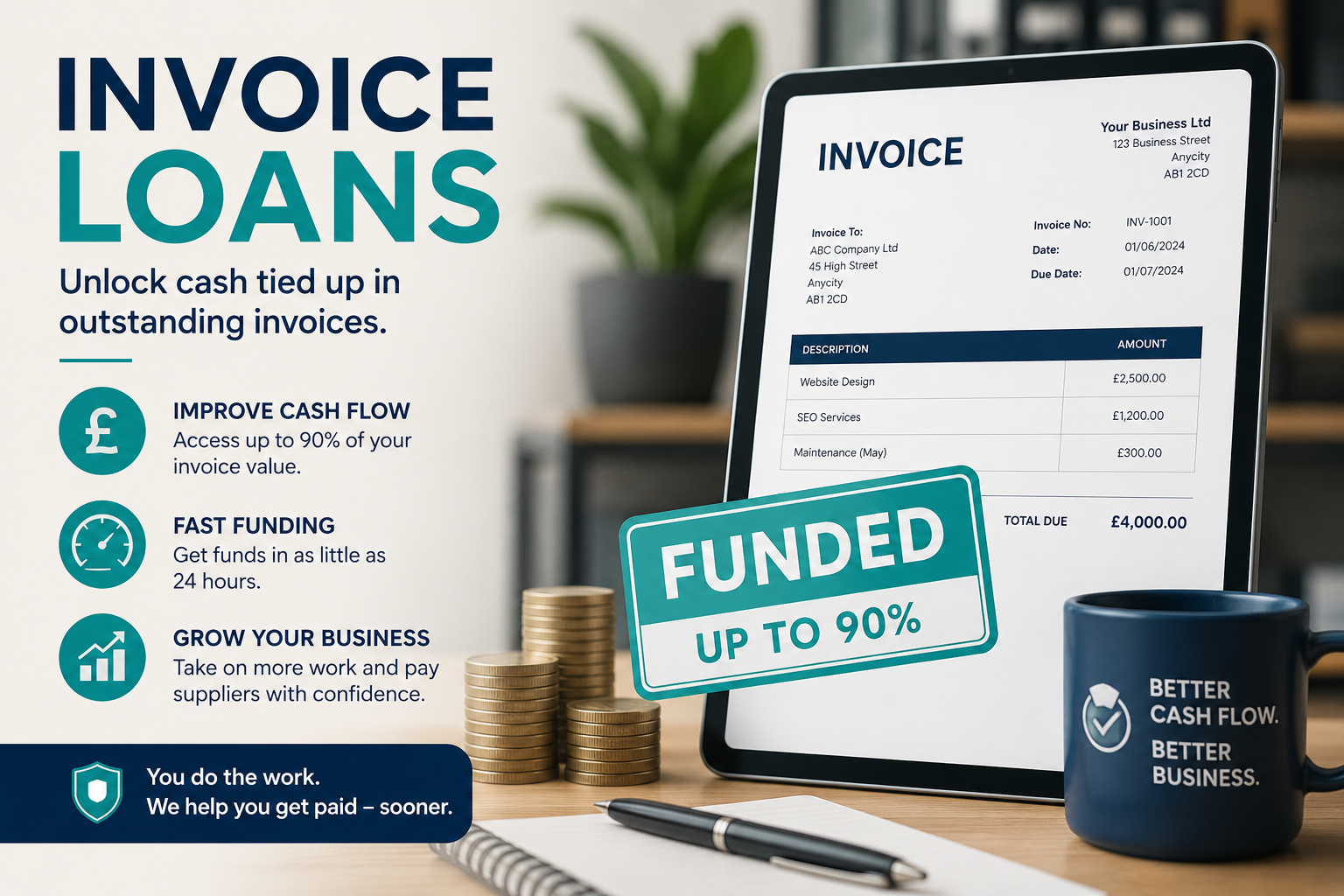
Invoice loans explained in under 3 minutes
If your UK business sells to other businesses on credit terms, you already know the frustration: you've done the work, sent the invoice, and now you wait 30, 60, or even 90 days for payment. Invoice loans let you unlock that money owed to you right now instead of later.
An invoice loan - sometimes called an invoice finance facility - uses your outstanding invoices as security rather than personal guarantees or property. A finance provider advances you a percentage of the invoice value, and you repay when your customer settles. Businesses can receive up to 95% of invoice value with invoice finance, and funds can be accessed within 24 hours of invoice approval. Invoice finance allows businesses to unlock working capital quickly, keeping your business moving even when delayed payments stack up.
Here is a simple example. A UK wholesaler issues a £50,000 invoice on 60-day terms. Rather than waiting two months with that cash tied up in unpaid invoices, the wholesaler uses an invoice loan to release cash quickly - receiving up to £42,500 within a day. That money covers supplier orders, wages, and VAT without missing a beat.
Invoice loans are not grants. They are a form of business loan secured on invoices, with clear costs involved, including fees and interest. Unlike traditional business loans or overdrafts, they offer faster decisions, greater flexibility, and a facility that grows as you raise more invoices.
In the sections below, we cover how invoice loans work step-by-step, the key types of invoice finance (invoice factoring vs invoice discounting), eligibility criteria, real cost breakdowns, and how to compare finance providers to find the right fit.

What are invoice loans and how do they fit into invoice finance?
Invoice loans sit within a broader family of working capital products known as invoice finance. Related terms - invoice financing, accounts receivable financing, receivables financing, and accounts receivables funding - all describe the same core idea: using your unpaid invoices as collateral to borrow against, rather than waiting for business customers to pay on their own schedule.
How the facility works. An invoice finance facility operates as a revolving credit line. Each time you raise a new invoice, it becomes eligible for funding. The provider advances a percentage (typically 70–95% of the value of your invoices), and once your customer pays, the provider deducts fees and returns the remaining balance. The cycle repeats with every new invoice, so the facility naturally scales with your sales.
Where invoice loans sit alongside other finance. In UK practice, invoice loans often complement asset-based lending solutions such as asset finance secured on machinery, vehicles, or inventory. An unsecured business loan gives you a lump sum based on your creditworthiness. An overdraft provides flexible short-term headroom but has fixed limits. An invoice loan sits between the two - secured on your sales ledger rather than property, with a limit that grows as your revenue grows.
Common sectors. Manufacturing, haulage, construction, recruitment, wholesale distribution, IT, and professional services all rely heavily on invoice loans because they typically operate with 30–90 day payment cycles. Invoice finance helps improve cash flow for 33,000+ SMEs across the UK, with over £22 billion advanced in the most recent quarter alone. Invoice finance is typically available for B2B businesses with a solid debtor book.
How invoice loans work step-by-step
Imagine you run a commercial cleaning company. You complete a contract for a large office building and issue a £20,000 invoice on 30-day credit terms. Here is how an invoice loan turns those existing unpaid invoices into immediate cash.
Step 1. You sell goods or services and issue an invoice for a specific amount - in this case, £20,000 on 30-day terms.
Step 2. You apply for an invoice loan against that invoice or submit your whole sales ledger to the provider. Businesses can access funding based on unpaid invoices as collateral, so your debtor book is the security rather than property or equipment.
Step 3. The invoice finance provider advances 70–95% of the invoice value. On a £20,000 invoice at 85%, you receive £17,000 as quick access working capital. Invoice finance provides up to 90% of invoice value quickly for most sectors, and some invoice discounting facilities offer up to 95% for strong ledgers. Funds are typically available within 24 hours of invoice generation.
Step 4. Your customer pays the invoice into a designated account. With invoice discounting, you usually retain control of collections, and the facility stays confidential - customers pay you as normal. With invoice factoring, the provider often manages your credit control process and payment chasing, so clients pay the factor directly.
Step 5. The finance provider deducts its fees (service fee plus discount charge) and returns the remaining balance to you. On that £20,000 invoice, if the fees total £250, you receive the remaining £2,750 of the balance.
The discount charge accrues daily on the amount drawn until the customer pays, making invoice loans genuinely short-term finance. The faster your customers pay, the lower your finance cost.
Types of invoice loans: invoice factoring vs invoice discounting
Not all invoice loans are structured the same way. The three main types of invoice finance each suit different business situations. Businesses can choose specific invoices to finance or their entire ledger, depending on their needs.
Invoice factoring
Invoice factoring involves selling your invoices to a factor who advances cash and manages collections on your behalf. Your customers know they are paying a third party - factoring is a disclosed arrangement. Invoice factoring provides up to 90% of the invoice value instantly, with advance rates typically sitting between 70% and 90%.
This option suits younger or fast-growing businesses with weaker internal credit control, as well as industry sectors like recruitment and haulage, where chasing customer payments is time-consuming. The provider handles sales ledger management, freeing you up to focus on operations, making small business factoring a particularly useful working capital tool.
Invoice discounting
Invoice discounting is borrowing against unpaid invoices while you manage your own sales ledger and collections. It is typically structured as a confidential service - your customers are unaware that a third party is involved. Advance rates can reach 90–95% for more established businesses with turnover often above £300,000. Invoice discounting allows businesses to retain credit control confidentially, which protects customer relationships.
An invoice discounting provider is a strong fit for businesses that already have robust ledger control and want to keep the financing arrangement invisible to their customers.
Spot and selective invoice loans
Selective invoice financing offers flexibility to finance chosen invoices rather than committing your whole ledger. Spot factoring allows financing of distinct invoices only - useful for businesses that occasionally face cash flow gaps rather than ongoing shortfalls.
These arrangements carry higher per-invoice fees but avoid long-term contracts. If you want to keep control and stay invisible to customers, discounting is typically the better route. If you want support chasing payments and prefer outsourced collections, factoring delivers that.

Eligibility: Which businesses can use invoice loans?
Invoice loans are designed for UK businesses that sell goods or services on credit to other businesses. Lenders usually require that revenue primarily comes from B2B transactions, and invoices should be paid within 30 to 90 days for approval. Consumer (B2C) invoices are typically excluded or advanced at much lower rates.
Turnover thresholds. Businesses usually need a minimum annual turnover of £300,000 for whole-ledger facilities, though selective finance can accept lower volumes. Invoice finance may not suit businesses with a turnover under £300,000 unless they use spot or selective products. Some providers only accept businesses with a minimum monthly invoice to justify the facility’s administration.
Debtor quality matters more than your balance sheet. Providers assess the creditworthiness of your customers rather than solely your own financials. A clean, verifiable sales ledger with clear invoice terms and proof of delivery is essential. Businesses need to have reliable B2B customers for invoice financing to work effectively. Providers may require a trading history to assess eligibility - typically one to two years.
Concentration risk and disputes. If one customer represents over 50–60% of your ledger, expect reduced advance rates or higher fees. Frequent disputes, credit notes, or aged invoices over 120 days are often excluded entirely.
Consider two examples. A two-year-old recruitment agency with £500,000 turnover and several mid-sized clients might qualify for factoring with moderate fees. Meanwhile, a ten-year-old manufacturer with blue-chip customers and £2 million turnover would likely secure invoice discounting facilities at lower rates. The stronger and more diversified your debtor book, the better your terms - regardless of your own company's size.
Costs involved in invoice loans
Understanding the costs involved in invoice loans is critical before committing. The total invoice finance cost breaks down into several components, and the final figure depends on your sector, debtor quality, and how quickly your customers pay.
Service fee. This covers administration and, in factoring, collections management. For factoring, typical service fees range from 0.5% to 3% of turnover. For discounting, service fees are lower - often 0.2% to 0.5%. Costs include service fees and interest rates on advances, so both elements contribute to the total.
Discount charge. This is interest charged on the money advanced to you, accruing daily until your customer pays. With the Bank of England base rate at 3.75%, most providers add a margin of 1.5% to 3.5% above base, giving an effective rate of roughly 5.25% to 7.25% on drawn funds.
Other charges. Setup fees typically range from £500 to £2,000. Minimum usage fees, audit fees, CHAPS transfer charges, and termination or notice-period fees can add up. Always ask about these before signing an invoice finance agreement.
Worked example. On a £50,000 invoice with an 85% advance (£42,500) over 45 days, the discount charge might total around £330 and the service fee around £500 - roughly £830 total, or about 1.66% of the invoice value. If the customer takes 90 days instead of 45, the discount charge approximately doubles. Invoice financing can be more expensive than traditional bank loans, especially for smaller or riskier facilities - annualised costs can range from around 5.5% for large, stable businesses up to significantly higher rates for single-invoice or high-risk funding.
Improving your own credit control process - chasing invoices faster, resolving disputes promptly - directly reduces the time money is drawn and therefore your overall finance cost. Always compare fee structures between finance providers and watch for hidden extras.
Invoice loans vs traditional business loans and overdrafts
Choosing between an invoice loan, a term business loan, an overdraft, or asset finance depends on what you need the money for and how your business generates revenue.
Term business loans give you a fixed lump sum with a fixed repayment schedule. They often require business assets or personal guarantees as security and suit long-term capital expenditure - buying equipment, expanding premises, or funding a major project. The application process is slower and the limit is fixed at the outset.
Bank overdrafts offer flexible short-term headroom within your business banking arrangement. However, limits are typically capped regardless of how fast you grow, and banks review them regularly. An overdraft does not scale with your revenue.
Asset finance is secured on plant, vehicles, or equipment - your existing assets - rather than unpaid invoices. It is useful for purchasing or leasing physical items, but it does not address the working capital gap caused by slow customer payments.
**Invoice loans fill a different gap. The facility limit grows in line with your sales ledger, giving more funding as you raise more invoices. Security is the debtor book itself, so you often avoid pledging property or signing personal guarantees (though some providers request these for smaller firms). Once set up, drawdowns are fast - typically within 24 hours. Invoice financing can help manage short-term cash flow gaps like payroll, supplier costs, and VAT, and it often sits alongside other alternative funding options for small businesses.
Consider a haulage firm relying solely on a £30,000 overdraft. During a busy quarter, invoices outstanding climb to £150,000 but the overdraft does not flex. Adding an invoice finance facility gives the firm access to £100,000+ of working capital that grows with demand - and the two products can sit alongside each other because they are secured on different things.
How invoice loans affect your credit control process and customer relationships
Using invoice loans changes how payments flow through your business, and the impact depends on whether you choose factoring or discounting.
Under a factoring arrangement, the factor may send invoices under their own or a trust account name, chase late payers directly, and set and monitor credit limits for your customers. This hands-off approach saves you time on sales ledger management but means your customers interact with a third party. Customers may prefer not to have a third party involved in collections, so clear communication is important. Let clients know that using invoice finance is standard practice across many industry sectors - it does not signal financial distress.
With invoice discounting, your existing credit control process stays in place. Customers continue to pay you (or a trust account that looks like yours), and the arrangement remains confidential. This preserves customer relationships and avoids awkward conversations.
Regardless of the type, strong internal systems improve outcomes. Issue invoices promptly, chase at fixed intervals (for example, a reminder at 7 days before due date and again at 3 days overdue), resolve queries quickly, and always obtain signed proof of delivery. These practices reduce disputes that can cause invoices to be excluded from funding or lower your advance rates.
Customer dependence can lead to financial risk if clients default. If you rely heavily on a small number of customers, a single default can create a serious problem. Bad debt protection - available as an add-on from many providers - can mitigate this risk, though it usually only covers debtor insolvency rather than contractual disputes.
A robust ledger control approach, combined with clear contracts and accurate billing, keeps your debtor book healthy, your advance rates high, and your finance cost low.
Confidential service options and privacy considerations
Privacy concerns arise if customers know about invoice factoring, which is why many businesses opt for confidential invoice discounting instead.
In a confidential arrangement, customers pay into a designated trust account that appears to be your own. Credit control letters go out under your company name, and the finance provider reconciles payments behind the scenes. Your customers have no reason to suspect a third party is involved. This matters most for professional services firms, businesses with long-term contracts, and any company where sensitive supplier relationships are at stake.
By contrast, disclosed factoring notifies customers that a finance provider has taken assignment of the debt. Payment instructions on invoices change, and the factor's name may appear on correspondence. In sectors like haulage and recruitment, this is widely accepted and rarely causes concern.
When evaluating a prospective invoice discounting provider, ask specifically: how do they handle outbound communications? What do customers see on statements and reminders? What happens if an account becomes seriously overdue - will they contact the customer directly? Understanding these details upfront avoids surprises later. Some providers offer a blended approach, keeping the arrangement confidential under normal circumstances but stepping in with direct contact only when an invoice is significantly past due.
Benefits of invoice loans for improving cash flow and growth
The primary advantage of invoice loans is straightforward: you gain quick access to working capital without waiting for the customer to pay. This turns your debtor book from a liability into a productive asset.
Businesses can receive up to 95% of invoice value upfront, meaning the vast majority of money owed to you is available within hours rather than weeks. Invoice finance scales with business turnover and sales growth - the more you sell, the more you can draw. This makes it particularly powerful during seasonal peaks or periods of rapid expansion, keeping your business cash flow stable even as volumes fluctuate. Invoice finance can scale with business growth and sales increases without requiring a new application each time.
Practically, improving cash flow through invoice loans means you can pay suppliers early (sometimes capturing early-payment discounts), meet payroll on time, cover VAT, and invest in stock ahead of large orders. You do not need to give up equity as you might with an investor, and you retain full ownership and control of your business.
Consider a recruitment agency that pays contractors weekly but only receives payment monthly from its clients. Using an invoice finance facility to bridge that gap, the agency can confidently take on more placements, access the funds it needs for weekly payroll, and grow revenue without cash flow holding it back. For small and large businesses alike, this type of facility supports business growth when combined with solid financial planning and profitability.

Risks and drawbacks to consider before using invoice loans
Invoice loans are not without downsides, and understanding these before signing up will save you problems later.
Cost over time. Overall cost may be higher than a secured term loan or overdraft if used continuously. The combination of service fees, discount charges, and ancillary costs can add up - particularly for small and medium businesses with tighter margins. Run projections comparing scenarios: trading with and without invoice finance, and stress-test for slower customer payments or a temporary sales downturn.
Customer payment risk. Your facility depends on customers paying on time. Without bad debt protection, if clients default, the debt can fall back on you under recourse arrangements. Customers failing to pay create problems that ripple through your entire facility - potentially reducing your available funding just when you need it most.
Admin burden. Submitting invoices, reconciling payments, and ongoing reporting require more administrative effort than a simple lump-sum commercial finance product. The workload is often underestimated.
Customer perception. In disclosed factoring arrangements, some customers may view the involvement of a third party negatively. Managing this through clear communication and high-quality service is important.
Contractual lock-ins. Many providers require minimum term agreements - often 12 months - with notice periods and exit fees. This can restrict your ability to switch providers quickly if you find a better deal or your needs change.
Credit checks. Invoice finance can affect your credit report due to checks run during the application process. If personal guarantees are requested (common for newer or smaller businesses), this may also touch your personal finance credit file.
Before committing, compare at least two or three providers, understand every fee line, and make sure the contract terms match your business plans, or consider using a commercial finance lending platform to streamline comparisons.
How to choose an invoice loan provider and set up a facility
Finding the right funding partner starts with understanding your own requirements and then comparing what the market offers. Major banks like Lloyds Bank Commercial Finance (part of Lloyds Bank plc) and RBS Invoice Finance offer invoice finance solutions alongside their business banking products, as do business and commercial lending platforms that aggregate multiple lenders. Specialist commercial finance firms and fintech lenders - such as Ultimate Finance - often provide more flexible terms or faster onboarding for smaller businesses, sometimes via a loan origination marketplace that lets multiple lenders compete on terms. All major bank-backed providers are regulated by the Prudential Regulation Authority, which provides an additional layer of oversight. Look for providers that adhere to asset based lending standards set out by UK Finance and industry bodies.
Key questions to ask each provider:
- What are your maximum advance rates and typical percentage for my sector?
- What is the full fee structure, including any minimum monthly charges?
- Do you offer both invoice discounting and factoring, plus optional bad debt protection?
- How quickly can you approve and release funds - for example, within 24 hours of invoice upload?
- Can you handle overseas debt if I invoice international customers?
Documentation you will need. Recent management accounts, aged debtors and creditors reports, sample invoices, a customer list, and bank statements. Providers use these to assess debtor quality and your minimum turnover against their thresholds.
Onboarding. Expect due diligence, legal documentation, notification to customers (if factoring), and integration with your accounting or invoicing system. The process typically takes two to four weeks from initial enquiry to first drawdown.
Review the facility after the first 6–12 months. Check whether pricing remains competitive, service quality is meeting expectations, and whether the limit still matches your growth plans. If you need support adjusting your setup or exploring alternatives, contacting a specialist funding platform directly can help you compare options. An invoice finance agreement should work for you, not lock you into a facility you have outgrown.

Invoice loans in your wider funding strategy
Invoice loans work best as one part of a broader capital structure rather than a standalone fix. Combining them with other funding tools - such as term business loans for capital expenditure, asset finance for equipment, and trade credit insurance for debtor protection - creates a more resilient financial foundation.
For project-based businesses managing milestones and staged invoices, invoice finance bridges the gap between completing work and receiving payment. High-volume, low-margin traders use invoice finance to keep stock moving without running out of cash. Service firms that need to cover payroll while waiting for retainers or monthly invoices rely on it to keep established businesses running smoothly.
When is an invoice loan a good fit? When you have a strong, diversified debtor book, B2B credit terms of 30–90 days, and a genuine cash flow gap between delivering work and getting paid. When is it not? If your business is persistently unprofitable, invoice finance will not solve the underlying problem - it will simply add another finance cost. Businesses with very few customers, heavy dispute rates, or primarily B2C revenue will also struggle to make it work.
If you are unsure, speak to a professional adviser or finance broker who can assess your debtor book, compare providers, and help you structure a facility that supports sustainable business growth. Many advisers now leverage open banking for faster, data-driven SME lending decisions, which can improve both approval speed and funding terms. Getting the right invoice finance work done upfront means your business can grow confidently, with cash flow supporting your ambitions rather than holding them back.