

All Posts
5 min read
Alternative funding for business: modern options beyond the bank
Published on 30 August 2026
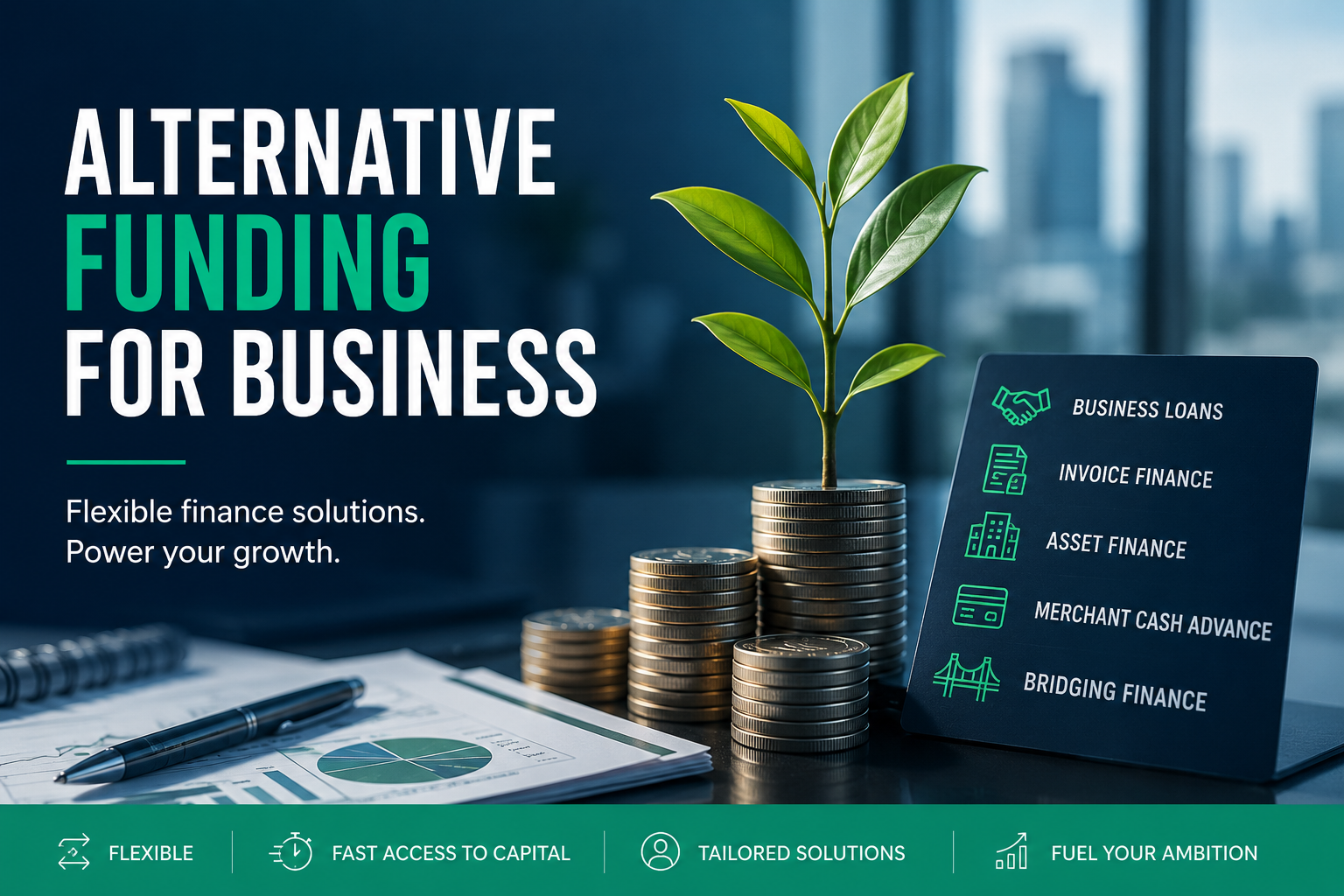
If your business needs capital and the high street bank said no-or said "wait six weeks"-you are far from stuck. The landscape of alternative business funding has changed dramatically, and UK businesses now have more ways to raise capital than ever before.
This guide breaks down every major alternative funding option available to UK businesses, from merchant cash advances and invoice finance to business angels, venture capital and government grants. Whether you run a start up or a medium sized business, you will find a route that fits.
Fast answers: is alternative business funding right for you?
Alternative business funding is any source of business finance outside mainstream high street banks. That includes specialist UK lenders, online platforms, business angel funding, venture capital funds, crowdfunding, peer to peer lending and government grants. Unlike traditional bank lending, these routes often use different eligibility criteria, faster timescales and more flexible structures.
Small businesses can grow without traditional bank loans. Alternative funding can provide access to capital within 24-48 hours in many cases, compared to the weeks or months a conventional bank application can take.
Alternative finance is worth exploring if:
- You have been declined by a high street bank or offered unfavourable terms
- You need a decision within 24–72 hours
- Your business has strong card sales or recurring revenue but weak collateral
- You are a new business without lengthy trading history or formal audited accounts
- You want flexible repayments that track revenue rather than fixed monthly instalments
- You want to raise capital without giving up equity
UK businesses now raise billions each year through non-bank routes. Alternative business lending reached approximately £2.77 billion annually before the pandemic, while asset finance for SMEs stood at roughly £22.6 billion in 2024. Funding sizes range from £5,000 merchant cash advances up to £2 million or more in asset finance or venture capital rounds.
A fintech marketplace like FundingSearch lets you compare multiple UK lenders and alternative business funding providers in one place, matching your financial needs to the right funding options across seven product categories, effectively acting as a business and commercial lending platform for UK borrowers.
What is alternative business funding?
Alternative business funding covers any business finance that does not come from a mainstream high street bank. This includes challenger banks, specialist UK lenders, online platforms, community funding bodies, business angels and venture capital. Alternative finance includes crowdfunding and peer-to-peer lending alongside debt instruments from non-bank providers.

The options split into two broad categories:
- Debt-based: business loans, invoice finance, asset finance, merchant cash advances, revenue-based finance. You borrow money and repay with interest or fees. No ownership dilution.
- Equity-based: business angels, venture capital, equity crowdfunding. Investors provide capital in exchange for shares. No fixed repayments, but you give up a stake.
Alternative finance has grown since around 2010 in the UK, driven by post-financial crisis bank retrenchment, the rise of digital-first lenders, and open banking and accounting data integrations through platforms like Xero and Sage.
How alternative finance differs from bank lending:
- Eligibility: Alternative lenders assess cash flow, card takings or future revenue rather than demanding property collateral. Conventional financing typically involves higher scrutiny of creditworthiness and collateral.
- Speed: Decisions in hours or days, not weeks
- Documentation: Real-time accounting data rather than audited annual accounts
- Flexibility: Repayments can track revenue; some allow early settlement without penalties
- Credit impact: Many providers use soft searches that minimise impact on your business credit score
Debt-based alternative business funding options
Most UK SMEs first look at debt-based alternative finance because it preserves ownership. For many, the starting point is understanding the main types of UK business loans and how they compare with other borrowing options. Here are the core alternative business funding options in this category.
Unsecured business loans from alternative lenders typically range from £10,000 to £500,000, with terms of 6 to 60 months. Unsecured business loans do not require collateral, though personal guarantees may apply for larger amounts. Digital lenders assess applications using cash flow data and bank statements rather than relying solely on historic profits. Flexible business loans can be tailored to cash flow needs, and you can borrow up to £1,000,000 with flexible repayment options from some providers. Business loans can support urgent finance needs without collateral, and alternative lenders can provide funding within 24-48 hours.
Many alternative finance options are unsecured and flexible, which makes them particularly attractive for small businesses and start ups lacking business assets to pledge as security.
Merchant cash advances suit card-taking businesses in retail, hospitality and salons. A lender reviews your average monthly card takings and provides a lump sum. Repayment happens automatically as a fixed percentage of future card sales-typically 10–30%-so you pay less during quieter periods and more when trade picks up. Factor rates usually sit between 1.10 and 1.50, and businesses should understand how merchant cash advances work in the UK before committing.
Revenue-based finance is a newer option where businesses repay an advance as a share of monthly revenue. Revenue-based financing allows investors to receive a fixed percentage of ongoing gross revenues, making it popular with subscription and e-commerce firms that have predictable turnover but may lack the collateral for traditional lending sources.
FundingSearch can match borrowers to suitable business loans, merchant cash advances and other products by analysing real trading and accounting data in minutes.
Working capital solutions: invoice finance and asset finance
Cash flow gaps are a core problem for growing SMEs and new businesses. You pay staff and suppliers before your customers pay you-especially when invoices carry 30, 60 or 90-day terms. Working capital finance solutions increasingly rely on fintech innovation in commercial finance to bridge that gap.
Invoice finance comes in two main forms. Invoice financing includes options like factoring and discounting. Invoice financing unlocks cash tied up in unpaid invoices by advancing a percentage of their value upfront. Businesses can receive up to 85% of invoice value upfront, with the remaining balance paid after the invoice is settled.
Invoice factoring collects debts on behalf of businesses, which means the factor handles credit control. Invoice discounting is confidential-your customers never know a third party is involved. Sectors that rely heavily on it include manufacturing, recruitment, logistics and B2B services.
Selective invoice finance (single-invoice or spot factoring) lets you fund individual unpaid invoices rather than committing your whole sales ledger-useful for businesses that only occasionally need to provide finance against receivables.
Asset finance enables businesses to acquire physical equipment without large upfront costs. Equipment financing uses specific machinery as collateral to cover the cost of equipment. For example, you could spread the cost of a £150,000 CNC machine over five years via hire purchase, or fund a fleet of vans through contract hire.

Asset finance preserves cash flow because the asset itself acts as security, which is particularly valuable for thin-credit small businesses. UK asset finance new business grew from about £28.5 billion in 2016 to around £38.5 billion in 2024, reflecting strong demand across sectors.
Equity-based alternative business funding: business angels and venture capital
Equity finance trades ownership for growth capital and typically suits businesses with higher growth plans rather than everyday working capital needs. Investors seek businesses with strong growth potential and profitability.
Angel investors are high net worth individuals who invest in startups for equity and mentorship. Business angels typically invest from around £10,000 to £250,000 per deal, often through networks such as the UK Business Angels Association. Business angels typically invest in line with personal values, offering sector expertise and introductions alongside their own money. For new businesses, angel funding usually arrives at pre-seed and seed stages, frequently using SEIS and EIS tax reliefs to incentivise wealthy individuals. In the 2023-24 tax year, 2,290 companies raised £242 million via SEIS.
Venture capital funds operate at larger scale. Venture capitalists usually invest larger amounts than business angels, with typical ticket sizes from £500,000 to £5 million or more. They focus on scalable business models in SaaS, deep tech and fintech, and need a strong management team, clear business model and defined exit plan. Median UK seed deals sit around £1.1 million.
Venture debt is tailored for startups with existing equity investment and usually involves less dilution than equity financing, making it a useful bridge between debt and equity at growth stage.
Pros and cons versus debt:
- No monthly repayments or interest costs
- Access to mentorship, networks and future profits growth support
- Loss of equity and some control; investor rights, board seats and reporting obligations apply
- Founders must prepare a strong business pitch and accept dilution
Crowdfunding, peer-to-peer lending and community funding
These "marketplace" funding models pool multiple investors or lenders, typically via online platforms.
Rewards and pre-order crowdfunding (e.g. Kickstarter-style campaigns) works well for product-led businesses. Crowdfunding allows businesses to test ideas with potential customers and can provide funds quickly if the idea attracts supporters. The risk is failing to reach your target, in which case nothing is raised.
Equity crowdfunding lets UK companies seek investment from the public and individual investors in exchange for shares. Crowdfunding raises capital from the public and small investors, with popular crowdfunding platforms including Crowdfunder and Crowdcube. Typical raise sizes range from £50,000 to £3 million. These are FCA-regulated platforms with investor protections. Crowdfunding allows many people to invest small amounts online, but it requires a compelling pitch and business plan.

Peer p2p lending connects borrowers with individual investors online. Peer-to-peer lending for UK SMEs allows multiple investors to lend money to businesses, with interest rates typically higher than bank loans but lower than many short-term alternative lending products. Some p2p lending markets have pivoted to institutional capital since 2019. Microloans-small loans provided by non-profit organisations or peer-to-peer platforms-also fall into this category.
Community funding supports local businesses through social networks and local institutions. Community development finance institutions, local authorities and community share offers are particularly relevant for social enterprises and regionally focused small businesses. Business support organisations in many regions can point you toward these free resources.
Government support schemes, grants and specialist programmes
Grants and government-backed loans are not alternative finance providers in the traditional sense, but they are key parts of a blended alternative funding strategy and an important source of financial support and financial assistance.
Start up loan schemes such as the UK Start Up Loans Company offer up to £25,000 per director at fixed interest rates with mentoring support. They suit new businesses with limited trading history-even those with a weaker business credit score.
Government grants support innovation, R&D, net-zero investments and regional development. In 2016, the UK had over 537 government grant schemes. The Regional Growth Fund has raised over £16 billion for businesses. Many government grants do not require repayment, making them highly attractive additional capital. However, grants often require strict eligibility criteria and competitive applications-and many are match-funded rather than 100% free.
Regional and community programmes run by Growth Hubs, local combined authority funds and sector-specific accelerators offer small grants plus support. These are especially useful for businesses in the early stages looking to safeguard jobs and accelerate digital innovation.
Treat grants as one layer in a broader funding stack. Competition is high, eligibility criteria are strict, and application timelines are long-so they supplement alternative funding options rather than replace them.
How to choose the right mix of alternative finance for your business
Successful funding strategies often involve combining multiple sources of finance. Most SMEs end up using a blend-for example, asset finance plus invoice finance, or a small unsecured loan plus angel funding-rather than relying on a single source, particularly for business startup funding strategies in the UK.
Key decision factors:
| Factor | Questions to ask |
|---|---|
| Stage | Pre-revenue, early revenue or profitable? |
| Purpose | Assets, working capital or growth plans? |
| Dilution appetite | Will you give up equity to raise finance? |
| Speed | Do you need funds in days or can you wait months? |
| Security | What collateral or business assets can you offer? |
Calculate how much to borrow or raise by stress-testing repayments against realistic cash flow scenarios. Avoid over-reliance on any one lender, and factor in all costs-interest, fees, factor rates-before committing.
Tools like multiproduct marketplaces and commercial finance broker software help advisers and commercial finance brokers quickly compare business loans, invoice finance, asset finance and other funding solutions from multiple UK lenders. For larger or more complex deals, seek professional advice from accountants, commercial finance brokers or corporate finance advisers.
Using fintech platforms and data to access alternative business funding
FundingSearch is a UK-based fintech marketplace launched in 2025 to connect SMEs, finance brokers and lenders across seven core product areas: business loans, commercial mortgages, bridging, invoice finance, asset finance, asset-based lending and trade finance.
Open finance and accounting integrations-Companies House, Xero, Sage-allow verified financial data to be shared securely with lenders, reducing manual document gathering. Smart lender selection and verified financial data integration via a commercial finance lending platform streamline funding applications, cutting the time from enquiry to decision. In 2025, 61% of brokers submitted funding applications to non-bank lenders, reflecting how central alternative lending has become to UK business funding.
AI-driven matching algorithms shortlist suitable lenders based on sector, trading history, security available and funding purpose. Brokers and alternative finance providers can use platforms like FundingSearch as commercial lending origination software or a broader loan origination marketplace for UK business lending, managing workflows and deal pipelines while SMEs benefit from quicker, more accurate matches to the right funding. Platforms such as FundingSearch’s SME lending deal origination solution are designed specifically to streamline these processes.
Whether you are a limited company director looking to secure funding for a new project, or a broker helping clients navigate alternative finance options, treat digital marketplaces as part of your standard process-alongside direct approaches to business angels, venture capital funds and community financing bodies. The right funding for your business is out there. Start by matching your needs across multiple funding types and let data do the heavy lifting.